
Payment Infrastructure & Fault-Tolerant Gateways
Idempotency in Distributed Payment Gateways: Eliminating Duplicate Billing
Network timeouts between microservices and external banking rails present a classic distributed systems dilemma: did the charge succeed, fail, or remain unprocessed? Blind client retries without bulletproof idempotency primitives inevitably lead to double charges, severe regulatory penalties, and compromised customer trust.
This blueprint details how to build a zero-duplicate payment orchestrator. By combining cryptographically stable idempotency keys, distributed lock leases, relational unique state gates, and deterministic out-of-band status reconciliations, platforms can achieve strict exactly-once execution semantics across unreliable upstream banking networks.
Why Naive Payment Retries Trigger Duplicate Charges
Treating transient HTTP timeouts as definitive payment failures causes catastrophic double-billing across distributed payment rails.
The Ambiguous Timeout Retry
Double Charge RiskWhen an HTTP connection to an acquiring bank times out after 30 seconds, blindly issuing a retry without a shared idempotency key causes the bank to process two distinct debits.
Concurrent Double-Click Races
Client Race ConditionRapid consecutive client requests using identical payload payloads bypass application-level checks unless backed by an atomic distributed lock lease or database constraint.
Payload Mutation with Reused Keys
Mismatched FingerprintReusing an existing idempotency key with an altered transaction amount or currency without parameter fingerprinting can lead to corrupted state records or uncollected revenue.
Ephemeral Memory Key Loss
State VolatilityStoring idempotency records exclusively in Redis without persistence guarantees causes lock releases and duplicate charge executions when a Redis node failover or restart occurs.
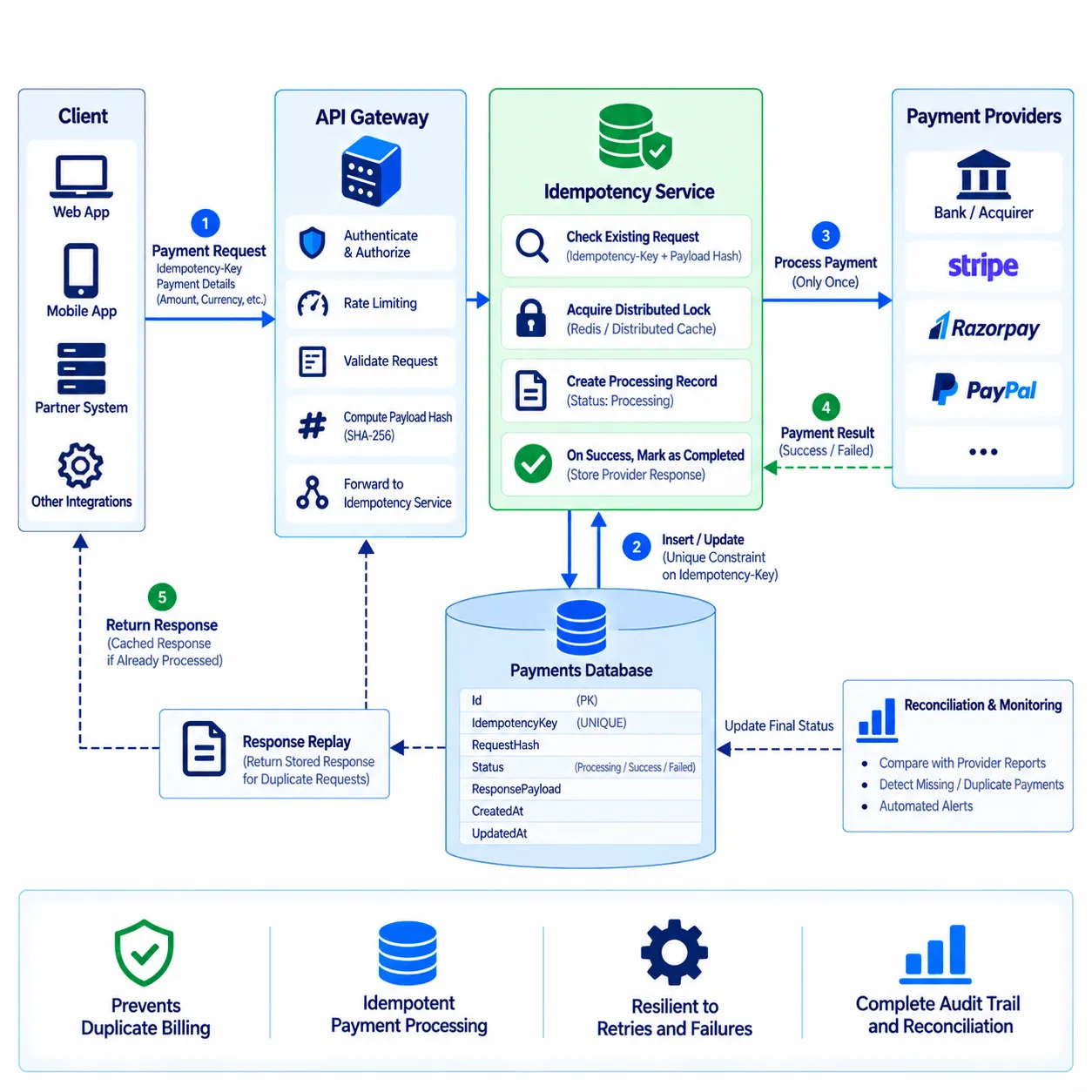
The 4-Layer Idempotent Payment Flow
A deterministic state machine verifying idempotency keys and acquiring atomic locks before dispatching outbound banking commands.
Key Ingestion & Payload Fingerprinting
Extract the client-supplied Idempotency-Key header. Compute a cryptographic SHA-256 hash of the normalized request payload (amount, currency, customer ID) to detect malicious or unintended key re-use.
Atomic State Gate & Lease Reservation
Insert an initial 'PROCESSING' payment intent record with a database unique index on the idempotency key. If a concurrent call attempts insertion, reject it with a 409 Conflict or 429 status.
Upstream Call with Downstream Token
Dispatch the payment command to the external processor passing the deterministic transaction identifier. Maintain state transition checkpoints for pending, authorized, or failed responses.
Payload Caching & Response Replay
Transition the intent state to 'SETTLED' or 'FAILED' and store the full serialized HTTP response payload. Any subsequent identical requests bypass the bank and instantly replay the saved response.
Concurrency Strategies: In-Memory TTL Locks vs. Relational State Gates
Contrasting throughput, fault-tolerance under cluster split-brains, and duplicate risk under heavy payment traffic.
| Dimension | Redis-Only Lock Leases (Redlock) | PostgreSQL Unique Index + State Machine |
|---|---|---|
| Consistency Guarantee | Vulnerable to asynchronous replica lag, node restarts, and GC pauses exceeding lease TTLs. | Strict ACID serializability. Database unique constraints eliminate race windows by design. Absolute zero-duplicate guarantee on the relational tier. |
| Throughput Overhead | Ultra-low latency sub-2ms lock acquisition; handles tens of thousands of lock tests per second. | Relies on database indexing; introduces 5-15ms write overhead per initial payment intent. Acceptable trade-off given the financial liability of duplicate transactions. |
| Timeout Recovery | Locks expire on TTL timeout, potentially allowing a retry while upstream is still executing. | Records remain in 'PROCESSING' state until explicitly verified via out-of-band webhook or poll. Prevents premature unlocks on long-tail banking delays. |
| Audit History | Ephemeral. Expired keys are evicted automatically without long-term audit trail retention. | Permanent immutable ledger of every payload hash, status transition, and response body. Simplifies disputed charge forensics and compliance audits. |
Engineering Guardrails & Trade-Offs
When to apply strict payment idempotency and operational rules for governing idempotency state life cycles.
When to Apply
- All non-idempotent financial operations including charges, fund transfers, refunds, and payout disbursements.
- Webhooks and third-party event consumers where network retries deliver duplicate event messages.
- Checkout APIs operating over mobile networks susceptible to frequent client packet drops and reconnections.
When to Avoid
- Read-only query endpoints (GET /charges) which are idempotent by HTTP specification.
- High-frequency analytics logging where duplicate events can be tolerated and database write latency is unacceptable.
- Internal deterministic calculations that produce zero persistent side effects.
Operational Caveats
- Idempotency records must have an agreed retention window (typically 24 to 72 hours) backed by automated table partitioning.
- If payload hash mismatches occur for an existing key, reject with a 422 or 400 bad request without altering state.
- Pending states older than 60 seconds must be reconciled via banking poll APIs before unlocking the lease.
Eliminate Duplicate Charges Across Your Payment Infrastructure
Engage with our distributed systems engineers to audit your payment gateways, resolve ambiguous timeout states, and implement rock-solid idempotency architectures.
- Mathematically verified zero-duplicate state machines
- Resilient network timeout and out-of-band reconciliation pipelines
- Zero vendor lock-in with standard PostgreSQL and Redis reference implementations