
Industrial IoT & Distributed Edge Fabrics
Edge-to-Cloud Telematics: Store-and-Forward Patterns for Offline-First Environments
Industrial fleets, offshore drilling rigs, and remote medical devices frequently operate across degraded, intermittent, or completely severed cellular connections. Direct-to-cloud streaming over unstable links leads to massive telemetry drops, buffer overflows, and corrupted operational intelligence.
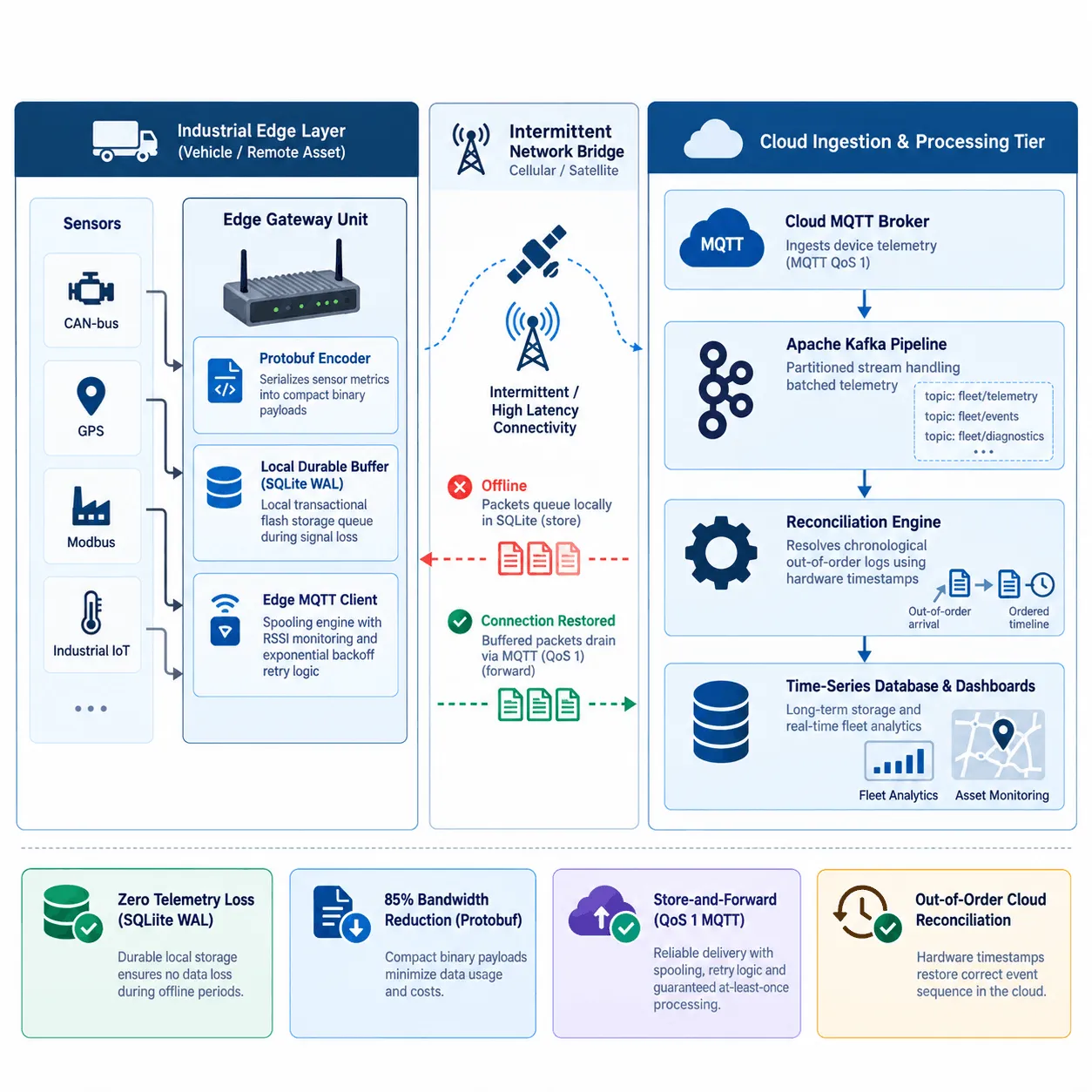
This blueprint outlines Codixon's resilient telematics architecture: coupling local flash-backed SQLite transactional queues, compact Protocol Buffers (Protobuf) binary serialization, bandwidth-optimized MQTT broker bridges, and deterministic eventual-consistency ingestion pipelines to guarantee zero telemetry loss across hostile network topologies.
Why Naive IoT Streaming Collapses in Degraded Networks
Attempting persistent, unbuffered TCP connections over intermittent cellular uplinks exhausts hardware memory and degrades remote asset diagnostics.
Volatile In-Memory Ring Buffer Drops
Buffer OverflowRelying on RAM-based queues during prolonged signal blackouts causes edge gateways to exhaust memory and silently drop high-resolution sensor packets when ring buffers overflow.
Bloated JSON Serialization Overhead
Bandwidth BloatTransmitting verbose ASCII JSON strings across metered satellite or 2G/3G cellular networks drives up payload sizes by 400%, generating massive cellular roaming costs and carrier throttling.
Replay Flood & Broker Thundering Herds
Thundering HerdWhen hundreds of edge units reconnect to cellular towers simultaneously after an outage, unthrottled burst replaying overwhelms cloud ingestion brokers, triggering cascading rate-limit rejects.
Chronological Out-of-Sequence Ingestion
State RegressionIngesting replayed historical data concurrently with real-time heartbeat feeds causes time-series databases to overwrite fresh operational states with delayed historical telemetry.
The 4-Layer Offline-First Telematics Pipeline
A fault-tolerant edge-to-cloud lifecycle guaranteeing transactional durability on local flash storage prior to encrypted cellular offloading.
Edge Sensor Polling & Protobuf Encoding
Collect CAN-bus, Modbus, and spatial telemetry at high frequencies. Serialize telemetry packets immediately into compact, strongly-typed binary Protocol Buffers to minimize byte size.
SQLite WAL Transactional Journaling
Persist encoded binary payloads into a local SQLite transactional ring buffer with Write-Ahead Logging (WAL) enabled. Protect against sudden power cuts and unexpected reboot state corruption.
Dynamic MQTT Spooling & Adaptive Replay
Continuously evaluate cellular network signal quality (RSSI). Drain local records via QoS 1 MQTT publishes with exponential backoff and adaptive batching as signal strength fluctuates.
Idempotent Ingestion & Timestamp Ordering
Receive batches via Kafka ingestion topics into cloud time-series engines. Use device-generated hardware timestamps to ensure historical replay logs never overwrite newer operational alerts.
Architecture Trade-Offs: Direct Cloud Push vs. Store-and-Forward Edge Buffering
Comparing data integrity, cellular data consumption, and edge operational stability under prolonged network disconnects.
| Dimension | Naive Direct Push (HTTP / Raw TCP) | Flash Store-and-Forward (SQLite + MQTT Protobuf) |
|---|---|---|
| Telemetry Durability | High packet loss. Transient network disconnects drop telemetry; power resets wipe volatile RAM buffers. | Zero loss. Every packet is committed to flash-backed SQLite with ACID guarantees before network egress. Survives total power cuts and weeks of uninterrupted network blackouts. |
| Cellular Bandwidth Usage | Excessive. HTTP headers and uncompressed JSON payloads consume 8x-12x more cellular bandwidth. | Minimal. Schema-compiled binary Protobuf payloads reduce transmission footprint by up to 85%. Massively decreases cellular SIM card roaming and data operational costs. |
| Power & Battery Profile | Drains battery. Constant connection keep-alive attempts and aggressive retries keep cellular modems energized. | Optimized. Batches telemetry transmissions during peak connectivity windows, putting modems to sleep when idle. Crucial for solar, vehicle-mounted, or battery-constrained edge gateways. |
| Replay Recovery Impact | Causes downstream ingestion spikes and DB thread starvation due to uncoordinated client reconnection bursts. | Regulated. Client-side rate-limiting and jitter-based backoffs smooth batch retransmission traffic curves. Protects cloud Kafka clusters and time-series DBs from denial-of-service spikes. |
Engineering Guardrails & Trade-Offs
When to implement edge store-and-forward architectures and how to prevent flash wear and queue starvation.
When to Apply
- Fleet management, avionics, maritime shipping, and mining telemetry operating across intermittent cellular bands.
- Remote industrial diagnostics where missing diagnostic error codes violates contractual warranties or compliance.
- Field health instrumentation that must record continuous patient telemetry without relying on active Wi-Fi.
When to Avoid
- Fixed data center applications connected via redundant, low-latency, hardwired fiber connections.
- Non-critical consumer gaming or social analytics where transient telemetry dropouts have negligible business impact.
- Ultra-low-cost microcontrollers lacking sufficient eMMC or NVMe flash endurance for write-ahead journal logs.
Operational Caveats
- Flash write endurance: Configure SQLite WAL checkpoint thresholds to prevent premature eMMC disk degradation.
- Queue eviction policies: Enforce strict priority drop rules (e.g., discard routine pings before critical alarms) if local storage fills.
- Clock drift: Rely on hardware RTCs or GPS time sources rather than OS uptime to prevent time-skewed telemetry packets.
Engineer Resilient Edge-to-Cloud Telemetry Pipelines
Collaborate with our distributed systems engineers to benchmark edge flash endurance, optimize binary serialization protocols, and eliminate telemetry loss.
- Zero-loss store-and-forward edge reference implementations
- Up to 85% bandwidth reduction via custom Protobuf and MQTT schemas
- Stress-tested eMMC and flash storage lifecycle management patterns