
Industrial IoT & Real-Time Signal Processing
High-Frequency SCADA Ingestion: Handling 10 kHz Vibration Streams Without Cloud Choke
Transmitting raw, uncompressed 10 kHz acoustic and vibration sensor data directly from factory floors to the cloud exhausts cellular uplinks, explodes telemetry storage budgets, and floods ingestion brokers with millions of unindexed time-series samples per second.
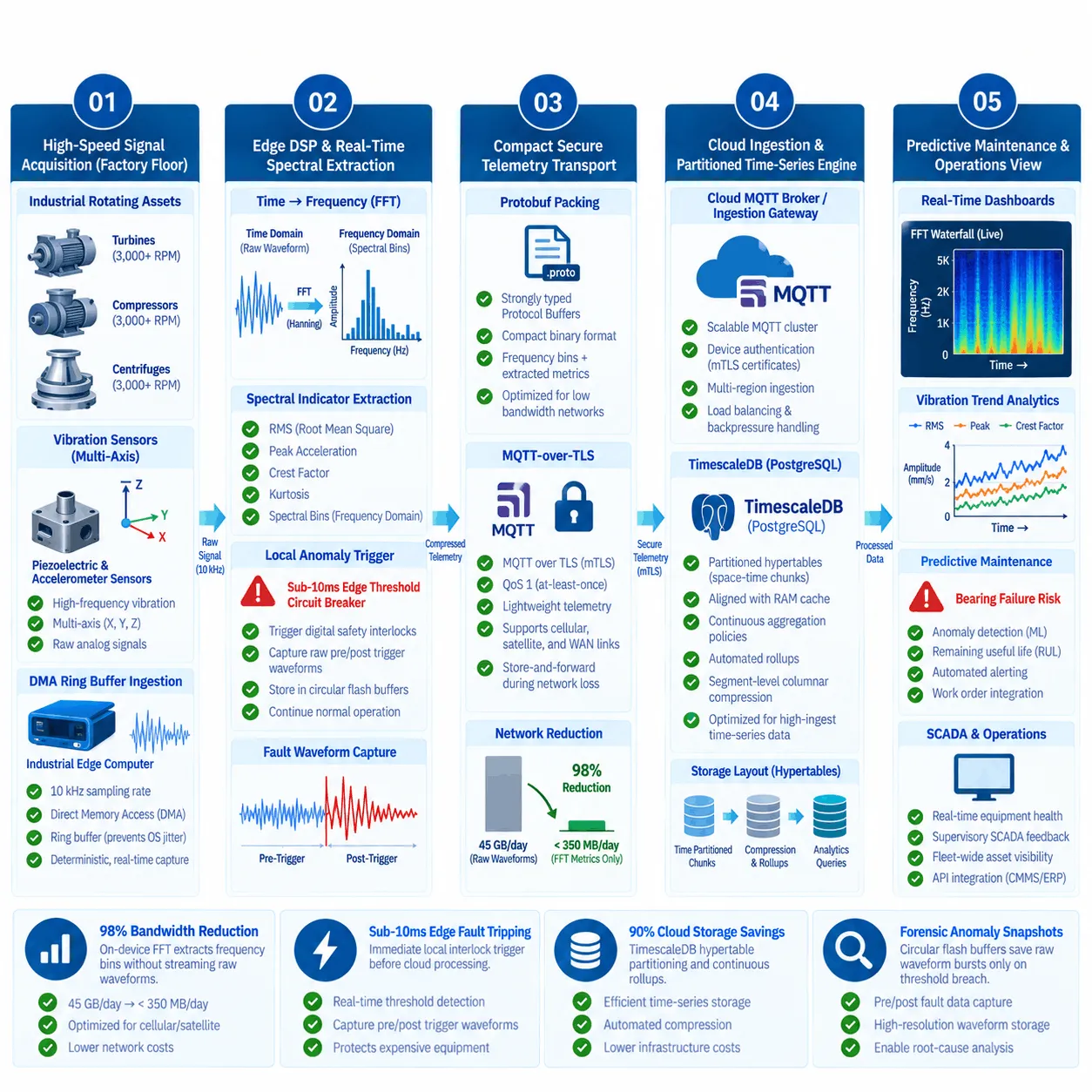
This blueprint details how Codixon engineers edge-accelerated SCADA architectures. By computing on-device Fast Fourier Transforms (FFT) for real-time spectral feature extraction, compressing residual anomaly snapshots, and streaming metrics across secure MQTT-over-TLS pipelines into partitioned TimescaleDB hypertables, industrial platforms retain microsecond fault detection while reducing raw transmission volumes by over 98%.
Why Raw High-Frequency Sensor Streaming Fails
Pumping raw, multi-axis analog streams directly into enterprise cloud infrastructure creates crushing operational and financial bottlenecks.
Cellular & Egress Bandwidth Saturation
Pipe SaturationStreaming 10,000 samples per second across three axes per machine generates gigabytes of data per hour, quickly saturating plant gateways and blowing past LTE/satellite bandwidth quotas.
Time-Series Hypertable Index Bloat
Index DegradationWriting billions of raw scalar float values directly to cloud time-series engines causes B-tree indexes to outgrow server RAM, tanking insert throughput and triggering I/O thrashing.
Cloud Ingestion Broker Choke
Broker CollapseDirect-to-cloud streams create millions of concurrent TCP network packets that overwhelm cloud load balancers and exhaust connection thread pools on ingestion brokers.
Delayed Anomaly Feedback Loops
Latency PenaltyOffloading vibration spectrum analysis to centralized cloud batch jobs delays bearing failure and cavitation warnings by minutes, missing the sub-second window needed for emergency shutoffs.
The 4-Tier Edge Spectral Ingestion Pipeline
An edge-to-cloud signal processing framework translating high-frequency vibration waveforms into compact frequency-domain features before cloud ingestion.
High-Speed Ring Buffer Ingestion
Sample multi-axis accelerometer and piezoelectric sensors at 10 kHz using DMA-backed ring buffers on industrial edge compute units, isolating sampling threads from OS scheduling jitter.
On-Device FFT & Feature Extraction
Execute windowed Fast Fourier Transforms (Hanning/Hamming) in local edge runtime. Compute key vibration health indicators—RMS, Peak Acceleration, Crest Factor, and Kurtosis—reducing thousands of points to concise spectral bins.
MQTT-over-TLS with Protobuf Packing
Pack frequency bins and health indices into compact Protocol Buffers. Stream payloads over persistent, mTLS-secured MQTT connections with QoS 1 to guarantee deterministic edge delivery.
TimescaleDB Hypertable Partitioning
Ingest spectral metrics into space-time partitioned TimescaleDB hypertables. Apply automated rollups, continuous aggregates, and columnar compression policies to retain long-term trending.
Ingestion Paradigms: Raw Streaming vs. Edge FFT Feature Extraction
Benchmarking egress bandwidth consumption, anomaly detection latency, and cloud infrastructure cost across 500 monitored industrial assets.
| Dimension | Raw 10 kHz Stream Ingestion | Edge FFT + TimescaleDB Hypertables |
|---|---|---|
| Egress Bandwidth Footprint | Exceeds 45 GB per asset per day; causes cellular throttling and carrier overage penalties. | Under 350 MB per asset per day by extracting frequency bins and transmitting summary statistics. 98% reduction in network transmission requirements. |
| Fault Detection Speed | 5 to 15-minute delay while raw waveforms are ingested, queued, and processed in cloud pipelines. | Sub-10ms edge threshold triggers instantly trip digital safety interlocks and notify technicians. Real-time mechanical protection for turbines and high-speed bearings. |
| Cloud Storage Cost | Hundreds of millions of uncompressed floats quickly saturate primary disk arrays and backups. | Segment-compressed hypertables with automatic chunk dropping cut storage footprint by 90%. Sustainable long-term retention of historical machine health curves. |
| Network Failure Resilience | Dropouts permanently lose high-frequency fault indicators while network connections reconnect. | Edge circular flash buffers store full raw fault waveforms only when an anomalous spike is detected. Retains forensic raw data only when anomalies actually occur. |
Engineering Guardrails & Trade-Offs
When to deploy edge FFT feature extraction and critical operational constraints for high-frequency vibration streams.
When to Apply
- High-speed rotating machinery (turbines, industrial centrifuges, compressors) spinning above 3,000 RPM.
- Remote manufacturing plants operating over metered, high-latency, or costly satellite and cellular uplinks.
- Predictive maintenance systems where early bearing degradation, gear mesh faults, or harmonic imbalance must be flagged instantly.
When to Avoid
- Low-frequency environmental monitoring (ambient temperature, humidity, tank levels) where 1 Hz sampling is sufficient.
- Fully hardwired local lab environments with dedicated 10 Gbps fiber backbones and unlimited on-premises raw storage.
- Ultra-low-power microcontrollers without hardware floating-point units (FPUs) capable of real-time FFT computation.
Operational Caveats
- Sampling rates must strictly obey the Nyquist-Shannon theorem: sample at least 2.56x higher than the highest monitored frequency.
- TimescaleDB hypertable chunk sizing must align with available RAM so recent chunks remain in cache during high-throughput ingest.
- Always capture a pre-trigger and post-trigger raw waveform buffer on the edge when anomaly thresholds are breached for root-cause analysis.
Scale Your SCADA Telemetry Without Network Saturation
Collaborate with our distributed systems engineers to benchmark edge signal processing, eliminate cloud ingestion bottlenecks, and build resilient predictive maintenance pipelines.
- Zero-choke edge FFT and vibration feature extraction reference models
- Over 90% reduction in raw cloud time-series storage overhead
- Hardened TimescaleDB and MQTT telemetry streaming architectures