
Geospatial Graph Systems & Fleet Optimization
Real-Time Geospatial Graph Search for Fleet Routing & Dynamic Dispatch
Dynamic fleet routing across thousands of active vehicles presents an NP-hard combinatorial challenge. As road network conditions change in real time, static pre-computed schedules collapse, causing driver detours, missed SLA windows, and wasted fuel.
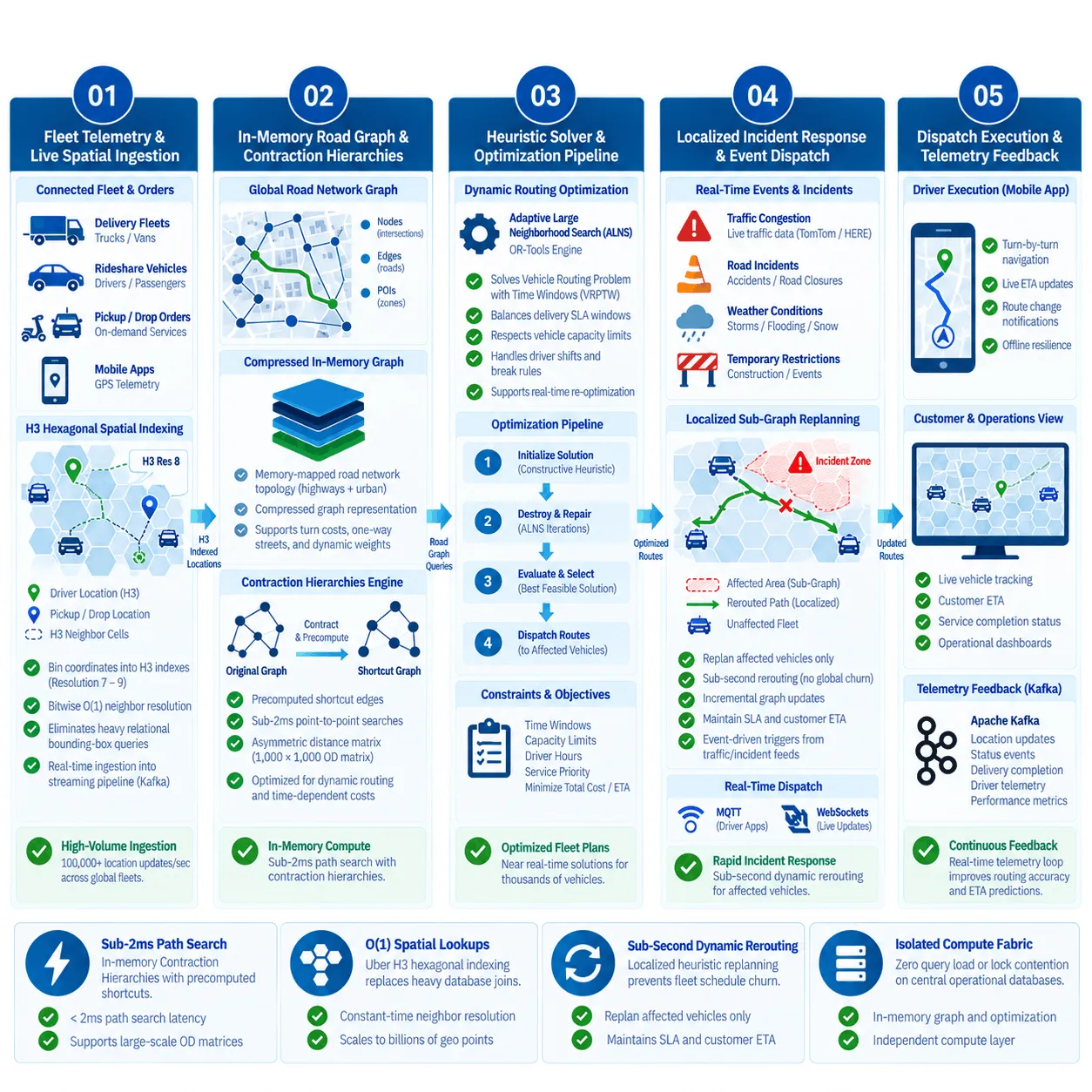
This blueprint details Codixon's high-throughput dispatch architecture. By pairing Uber H3 hexagonal spatial indexing with in-memory Contraction Hierarchies and heuristic solver pipelines (ALNS/OR-Tools), engineering teams can execute sub-second route recalculations, solve dynamic multi-vehicle routing problems with time windows (VRPTW), and dispatch reroutes mid-transit.
Why Traditional Fleet Dispatch Systems Stall
Relying on disk-bound spatial relational queries and brute-force routing engines creates severe computational bottlenecks during live fleet operations.
Combinatorial State Space Explosions
NP-Hard ExplosionAttempting exact solutions for multi-drop delivery routes across large vehicle pools leads to exponential CPU thrashing, causing dispatch solvers to timeout or fail under live re-routing demands.
Disk-Bound Relational Spatial Joins
I/O ChokepointsExecuting heavy PostGIS ST_DWithin and polygon containment queries inside active dispatch loops saturates database disks, degrading location lookups to multi-second delays.
Static Distance-Matrix Assumptions
Routing InaccuracyAssuming static travel times or simple Euclidean distances ignores dynamic urban traffic swings, leading to missed delivery windows and inaccurate customer ETAs.
Cascading Reroute Churn
Schedule ChurnRecomputing full fleet schedules from scratch for a single unexpected traffic delay causes massive itinerary shifts across unaffected drivers, confusing field personnel.
The 4-Stage Real-Time Routing Engine
A deterministic pipeline transforming incoming GPS telemetry and dynamic traffic feeds into real-time driver dispatch updates.
H3 Hexagonal Spatial Partitioning
Bin live driver GPS locations and delivery drop coordinates into hierarchical H3 discrete hexagonal indexes. Enable fast bitwise spatial neighbor operations and eliminate costly bounding-box geometry computations.
In-Memory Contraction Hierarchies
Maintain a compressed in-memory road topology graph. Precompute shortcut edges to enable sub-millisecond point-to-point path searches and asymmetric distance matrix lookups.
Time-Windowed Adaptive Local Search
Feed distance matrices into an Adaptive Large Neighborhood Search (ALNS) heuristic engine. Compute near-optimal stop allocations that honor strict delivery deadlines, vehicle capacity, and driver break rules.
Localized Event-Driven Rerouting
When live road congestion is detected, trigger localized sub-graph route re-evaluations for affected vehicles only, publishing turn-by-turn itinerary updates over MQTT or WebSockets.
Routing Paradigms: Relational Distance Checks vs. Hexagonal Graph Heuristics
Contrasting computational throughput, dispatch latency, and real-time reroute adaptability under production fleet scale.
| Dimension | Relational Spatial Queries + Standard Dijkstra | H3 Hex Indexing + Contraction Hierarchies + ALNS |
|---|---|---|
| Point-to-Point Path Search | 150ms - 600ms per origin-destination pair using standard A* or Dijkstra over database road tables. | Sub-2ms per query via memory-mapped Contraction Hierarchies with precomputed shortcuts. Enables rapid generation of 1,000x1,000 distance matrices. |
| Spatial Proximity Lookup | R-Tree spatial index queries introduce storage overhead and write lock contention during high telemetry ingestion. | O(1) bitwise integer operations via H3 cell indexes; nearest drivers resolved in microseconds. Zero spatial index contention on database layers. |
| Dynamic Incident Response | Batched global re-optimizations run every 15-30 minutes, missing localized incident windows. | Sub-second localized event-driven replanning pushes modified routes before vehicles reach congestion points. Real-time adaptability to changing urban traffic conditions. |
| Resource Consumption | High disk I/O and connection pool exhaustion on primary spatial relational databases. | In-memory graph processing nodes scale horizontally with zero dependency on central operational databases. Isolates core ERP and dispatch databases from heavy routing calculations. |
Engineering Guardrails & Trade-Offs
When to implement heuristic graph routing engines and critical operational caveats for real-time fleet dispatch.
When to Apply
- On-demand dispatch fleets (rideshare, last-mile delivery, field services) with high-density dynamic drop additions.
- Complex logistics systems with multi-vehicle capacities, driver shift constraints, and strict customer time windows.
- Fleet operations where live traffic diversions directly impact vehicle turnaround times and operating costs.
When to Avoid
- Static trunk-haul routes (e.g., long-distance freight linehaul) with predetermined waypoint schedules.
- Small fleets (< 10 vehicles) where off-the-shelf mapping APIs offer sufficient operational accuracy.
- Scenarios without real-time GPS telemetry feeds from active vehicles to validate route adherence.
Operational Caveats
- Contraction Hierarchies require periodic rebuilds when underlying road networks change (e.g., road closures or construction).
- Select appropriate H3 resolution levels (Resolution 7-9 for urban routing) to balance cell memory size and spatial precision.
- Enforce hysteresis thresholds before issuing reroutes to prevent drivers from receiving disruptive micro-adjustments.
Modernize Your Dynamic Dispatch & Routing Engines
Work with our distributed systems engineers to benchmark in-memory graph search, integrate H3 spatial indexing, and build high-efficiency fleet optimization systems.
- High-throughput in-memory Contraction Hierarchy graph implementations
- Sub-second heuristic solvers for dynamic multi-vehicle routing (VRPTW)
- Scalable, low-overhead spatial indexing architectures using Uber H3