
Distributed Streaming & Low-Latency Fabrics
Sub-100ms Event Streaming: Partitioning Strategies in Apache Kafka vs. In-Memory Fabrics
Targeting sub-100ms p99 end-to-end event latencies breaks down when platforms experience severe hot-key skew, uncoordinated consumer rebalances, or sub-optimal batch buffering. Unbalanced partitions lead to cascading consumer lag, pipeline head-of-line blocking, and unpredictable tail latency.
This blueprint benchmarks Apache Kafka against distributed in-memory streaming fabrics. We detail how to engineer sub-100ms event processing pipelines by applying composite hashing to mitigate partition hot spots, configuring cooperative sticky assignors to eliminate stop-the-world rebalances, and calibrating producer linger budgets under high write concurrency.
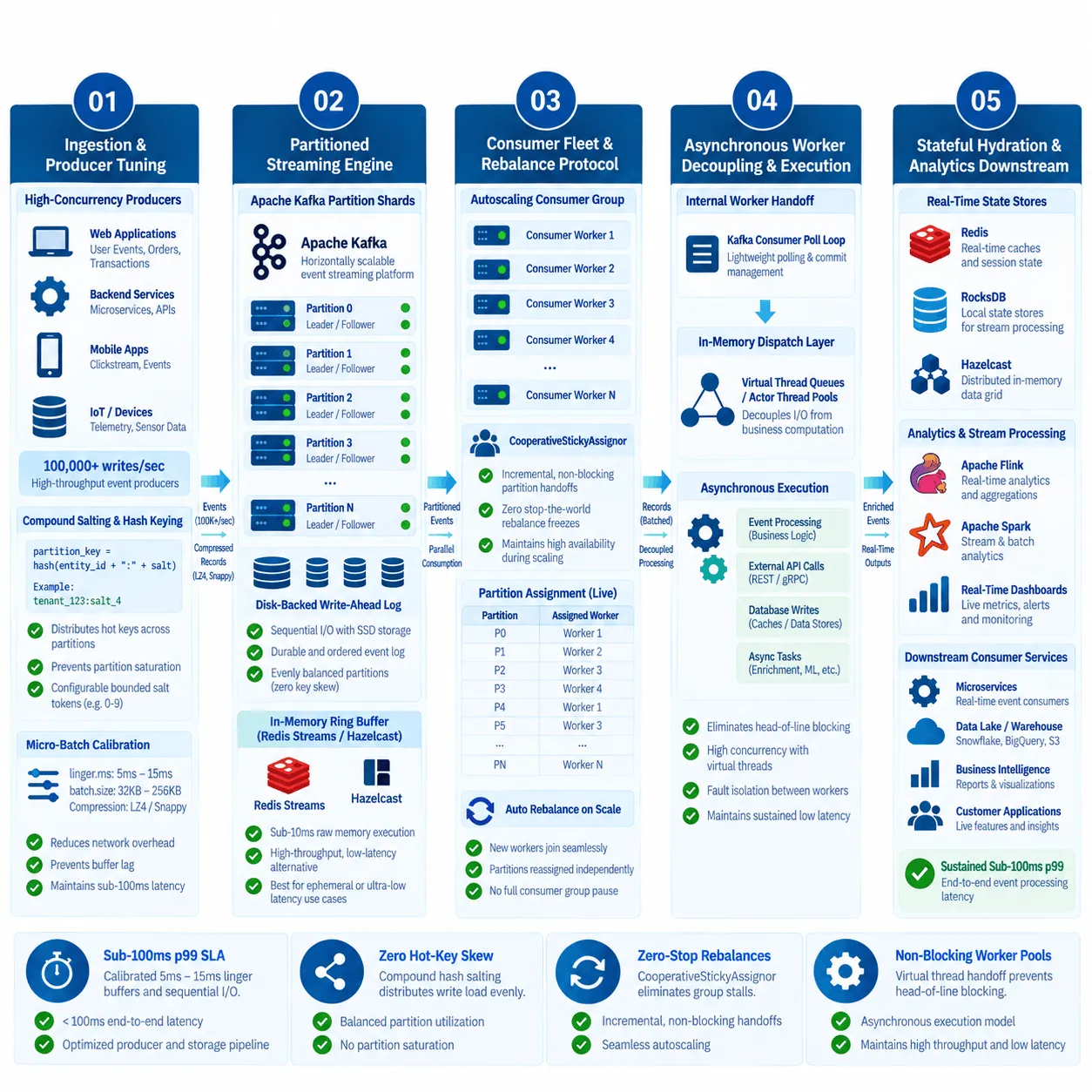
Why Streaming Latencies Collapse Under Concurrency
Naive partitioning keys, greedy buffering, and uncalibrated consumer protocols inevitably degrade high-throughput pipelines.
Hot-Key Partition Saturation
Key SkewRouting millions of events by a low-cardinality key (e.g., region or tenant) concentrates write traffic onto a single partition, exhausting dedicated broker threads while neighbor partitions sit idle.
Stop-the-World Consumer Rebalances
Rebalance FreezesEager consumer rebalance protocols revoke all partition assignments across an entire consumer group when a single pod scales or times out, stalling stream consumption for tens of seconds.
Unbounded Linger & Buffer Delays
Buffer LagMisconfiguring producer batch timeouts (linger.ms) and buffer thresholds trades away precious latency in a naive attempt to maximize compression ratios, inflating p99 delivery latency.
Head-of-Line Pipeline Blocking
Thread StarvationProcessing slow I/O or external network calls inline within partition listener loops blocks all subsequent chronological events assigned to that partition worker thread.
The 4-Stage Sub-100ms Streaming Pipeline
A deterministic pipeline combining balanced partition distribution, cooperative partition assignment, and asynchronous worker execution.
Compound Salting & Hash Partitioning
Combine business entity IDs with bounded salt tokens for high-volume entities. Distribute skewed writes across multiple parallel partitions while keeping related micro-batches deterministic.
Micro-Batch Buffer Calibration
Calibrate producer linger.ms (5ms to 15ms) alongside snappy/lz4 compression. Achieve optimal broker batching without accumulating latency buffers in producer memory.
Cooperative Sticky Rebalance Protocol
Configure CooperativeStickyAssignor across consumer fleets. Dynamically reassign only newly migrated partitions during horizontal autoscaling events, eliminating group-wide processing pauses.
Asynchronous Worker Decoupling
Handoff consumed records to internal in-memory actor pools or virtual thread queues, divorcing partition commit polling from downstream stateful business processing.
Fabric Comparison: Apache Kafka vs. In-Memory Streaming
Evaluating end-to-end delivery latency, storage durability, and failover behavior under 100,000+ writes/sec workloads.
| Dimension | Apache Kafka (Disk-Backed WAL) | In-Memory Fabrics (Redis Streams / Hazelcast) |
|---|---|---|
| p99 End-to-End Latency | 25ms - 80ms when tuned with low linger buffers, optimal segment sizes, and SSD storage. | Sub-10ms via purely memory-resident ring buffers and zero-disk default pipeline paths. In-memory fabrics provide the lowest raw latency floor. |
| Persistence & Replay | Durable, append-only commit logs allow replaying historical streams over days or weeks. | Ephemeral or bounded. Retention is strictly limited by cluster RAM capacity and eviction policies. Kafka guarantees persistent retention and replayability. |
| Throughput Ceiling | Sustains millions of events/sec across partitioned clusters with sequential disk writes. | Tied to network interfaces and single-threaded CPU memory ops per sharded cluster node. Kafka scales linearly across hundreds of consumer workers. |
| Rebalance Disruption | Zero disruption with cooperative sticky protocols; only migrating partitions experience brief handoffs. | Minimal. Key-directed routing avoids heavyweight partition reassignment coordination. Both architectures avoid stop-the-world pauses when properly tuned. |
Engineering Guardrails & Trade-Offs
When to select Kafka versus in-memory streaming fabrics and critical operational tuning guardrails.
When to Apply
- Pipelines requiring sustained sub-100ms p99 SLAs alongside deterministic event ordering.
- High-concurrency systems suffering from consumer group rebalance pauses or partition hot spots.
- Complex event-driven architectures where downstream microservices require reliable historical event replay.
When to Avoid
- Simple job processing queues where basic point-to-point brokers (RabbitMQ/SQS) satisfy the requirements.
- Low-throughput systems where managing Kafka broker clusters and ZooKeeper/KRaft quorum is unjustifiable overhead.
- Workloads demanding strict sub-millisecond atomic memory locks across multi-key operations.
Operational Caveats
- Always use CooperativeStickyAssignor instead of eager rebalance assignors to eliminate consumer group stalls.
- Monitor partition skew metrics (records-lag-max and bytes-in-per-sec) to identify hot-key imbalances early.
- Tune max.poll.interval.ms generously to prevent healthy consumer nodes from being evicted during long processing tasks.
Optimize Your Streaming Pipeline for Sub-100ms Latency
Collaborate with our distributed systems engineers to profile your broker partitions, tune consumer rebalance protocols, and eliminate tail-latency spikes.
- Zero-stop consumer group rebalance and partition-tuning patterns
- Proven key-salting frameworks eliminating partition skew and hot spots
- Rigorous benchmarking across Kafka, Redis Streams, and cloud-native fabrics