
Real-Time Runtimes & Distributed State Sync
Collaborative Canvases with Conflict-Free Replicated Data Types (CRDTs)
Engineering multi-user collaborative whiteboards with traditional central locks or Operational Transformation (OT) engines results in server-bound scaling ceilings, high edit latency, and intractable merge conflicts during intermittent offline edits.
This blueprint details Codixon's reference architecture for high-performance visual collaboration. By pairing State-based and Operation-based Conflict-Free Replicated Data Types (CRDTs) with binary delta compression, local indexed persistence, and GPU-accelerated WebGL/WebGPU rendering pipelines, distributed teams achieve mathematically guaranteed eventual convergence and 60 FPS stroke-accurate vector rendering under high concurrency.
Why Traditional Collaboration Models Break on Vector Canvases
Applying centralized document-collaboration models to 2D spatial vector engines causes severe desynchronization and interface frame drops.
Operational Transformation (OT) Server Bottlenecks
Centralized LagOT requires a single centralized coordinator to maintain a strict total order of transformations, creating unacceptable round-trip input lag and single points of failure.
Vector Stroke Interleaving Anomaly
Stroke CorruptionNaive array splicing during concurrent vector drawing causes points from different users' pens to interleave, turning smooth Bézier curves into corrupted zig-zag lines.
Offline Reconciliation Divergence
Silent Data LossWhen users disconnect and perform edits locally, reconnection replays with last-write-wins (LWW) heuristics silently overwrite concurrent edits made by online collaborators.
DOM/SVG Re-render Thrashing
Frame DropsBinding canvas vector nodes directly to HTML DOM or SVG trees triggers continuous layout recalculations during multi-cursor updates, dropping frame rates below 20 FPS.
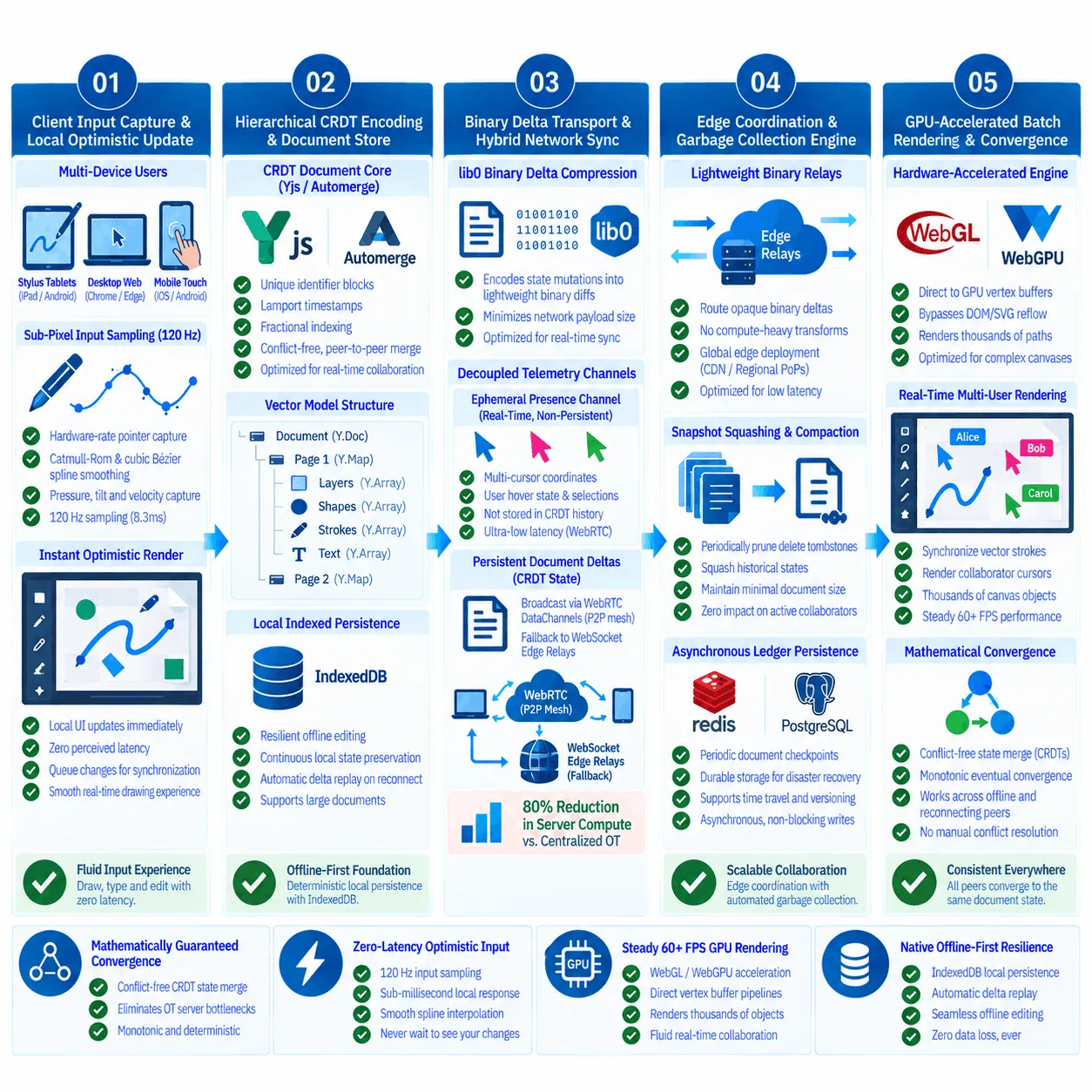
The 4-Stage Real-Time CRDT Sync Pipeline
A decentralized state-synchronization workflow reconciling vector state locally before broadcasting compressed binary state deltas.
Sub-Pixel Input Sampling & Spline Smoothing
Capture pointer events at the hardware refresh rate (120 Hz). Apply Catmull-Rom or cubic Bézier spline interpolation to generate smooth stroke curves locally with zero perceived latency.
Hierarchical CRDT Tree Representation
Model elements into a tree of CRDT types (Yjs/Automerge structures). Represent canvas items as unique identifier blocks with Lamport timestamps and fractional indexing for stable spatial ordering.
Binary State Delta Streaming
Encode document updates into compact binary diffs (lib0 format). Broadcast updates across WebRTC DataChannels for peer-to-peer peers, backed by low-latency WebSocket edge relays.
WebGL/WebGPU Batch Rendering
Stream reconciled state vectors directly into GPU vertex and index buffers. Render thousands of concurrent vector paths, shape nodes, and presence cursors at a steady 60+ FPS.
Collaboration Architectures: Operational Transformation vs. CRDTs
Contrasting merge determinism, offline capability, and infrastructure footprint between centralized OT and decentralized CRDT runtimes.
| Dimension | Operational Transformation (OT) | Conflict-Free Replicated Data Types (CRDTs) |
|---|---|---|
| Decentralization & Offline Support | Severely limited. Requires persistent server connection to assign operation order; offline merging is complex and brittle. | Native offline-first. Edits merge deterministically peer-to-peer or via server without central coordination. Guarantees zero merge conflict errors after network partitions. |
| Local Input Latency | Operations often wait for server acknowledgment before committing to avoid client-side rollback artifacts. | Instant optimistic local application; convergence occurs monotonically in the background. Delivers immediate tactile response on pen and pointer inputs. |
| Memory Overhead & History Tombstones | Low in-memory metadata footprint since the central server discards transformed operational history. | Higher memory footprint due to metadata identifiers and delete tombstones; requires periodic compaction. Mitigated by periodic snapshot squashing and document garbage collection. |
| Server Compute Costs | High compute requirements to calculate transformation matrices for every concurrent user operation. | Minimal server compute; edge servers act as lightweight binary relays without parsing payloads. Reduces real-time coordination server infrastructure costs by up to 80%. |
Engineering Guardrails & Trade-Offs
When to implement CRDT-based canvases and key operational constraints for memory and document lifecycle management.
When to Apply
- Spatial visual collaboration tools (whiteboards, flowcharts, UI canvas designers) with multi-user editing.
- Offline-first mobile and tablet sketching applications requiring seamless reconnection and sync.
- Distributed peer-to-peer applications aiming to minimize central server infrastructure overhead.
When to Avoid
- Simple single-user forms or transactional business dashboards with zero collaborative workflows.
- Workloads where strict central authorization checks must gate each individual keystroke or atomic point.
- Resource-constrained embedded platforms lacking sufficient client memory for CRDT document metadata.
Operational Caveats
- Implement periodic document snapshot compaction to eliminate accumulated tombstone metadata over time.
- Decouple high-frequency cursor tracking telemetry from persistent document CRDT state to prevent document bloat.
- Use Web Workers for parsing binary delta payloads to prevent blocking the UI animation thread.
Engineer High-Performance Collaborative Vector Engines
Collaborate with our distributed systems engineers to benchmark CRDT state convergence, eliminate document bloat, and build 60 FPS collaborative visual canvases.
- Production-grade CRDT state synchronization and conflict-free models
- Hardware-accelerated WebGL/WebGPU 60+ FPS rendering pipelines
- Zero-loss offline-first reconciliation and binary state compression