
API Orchestration & Edge Compute
Federated GraphQL Gateways: Unifying Multi-Service Catalogs at the CDN Edge
Composing modern enterprise frontends across dozens of decoupled microservices frequently degrades into an architectural bottleneck. Naive client aggregation triggers cascading N+1 network calls, over-fetching across high-latency backhauls, and uncoordinated schema drift across independent domain teams.
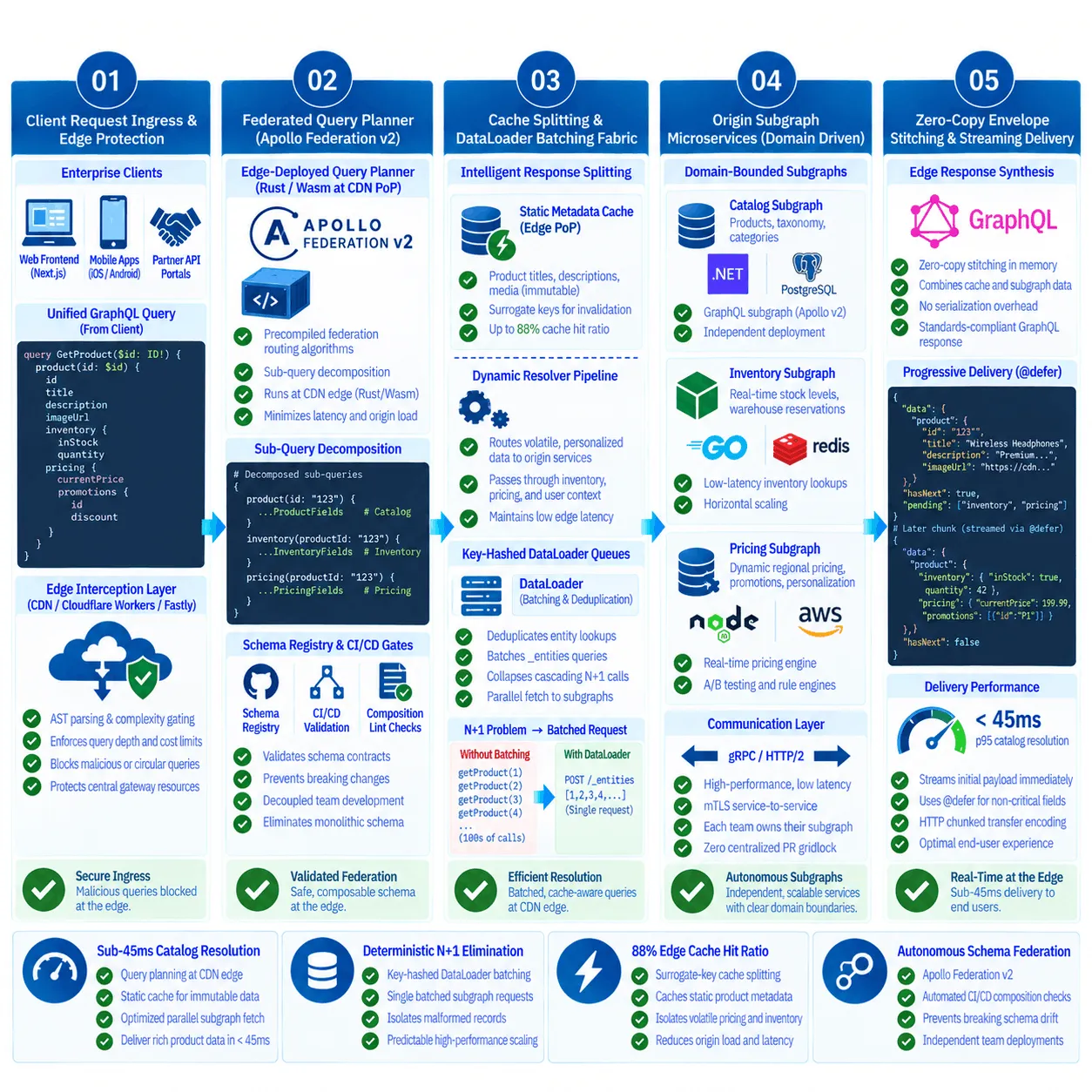
This blueprint outlines Codixon's edge-accelerated API orchestration architecture. By combining Apollo Federation v2 query planning at the CDN edge, sub-query DataLoader batching, surrogate-key cache invalidation for volatile pricing graphs, and cryptographic schema contract checks, platforms achieve sub-50ms catalog resolution while preserving bounded contexts across independent microservice domains.
Why Naive API Aggregation Fails at Scale
Centralizing microservice queries without federated execution boundaries creates severe downstream latency spikes and operational fragility.
The Distributed N+1 Cascading Storm
Thread StarvationResolving nested catalog fields across separate product, inventory, and pricing services issues hundreds of sequential HTTP calls per client view, saturating downstream thread pools.
Monolithic Schema Bottlenecks
Schema GridlockMaintaining a single, centralized GraphQL schema repository creates cross-team PR review gridlock, slowing delivery and triggering breaking schema changes across domain boundaries.
Uncacheable Dynamic State Blowouts
Cache Miss BlowoutCombining static product metadata with volatile, personalized pricing in single uncacheable GraphQL queries forces edge proxies to bypass caches, driving 100% of requests to origin servers.
Gateway CPU Exhaustion on Deep ASTs
AST SaturationParsing, validating, and compiling complex Abstract Syntax Trees (ASTs) for deeply nested queries inside a central Node.js gateway exhausts event loops under high traffic spikes.
The 4-Layer Edge Federation Pipeline
A decoupled query-planning pipeline that splits, caches, and batches sub-queries at the edge before orchestrating downstream origin fetches.
Edge AST Parsing & Complexity Gating
Intercept incoming GraphQL operations at the CDN edge worker (Cloudflare Workers/Fastly Compute). Validate query depth and cost limits to block malicious or circular payload attacks before execution.
Federated Sub-Query Decomposition
Execute query planning using precompiled Apollo Federation v2 routing algorithms. Deconstruct the incoming operation into targeted, parallel sub-queries mapped strictly to owning subgraph domains.
DataLoader Batching & Cache Splitting
Deduplicate and batch downstream entities using key-hashed DataLoader queues. Serve static product fields from edge caches with surrogate keys while fetching dynamic pricing via parallel HTTP/2 pipelines.
Zero-Copy Envelope Synthesis
Stitch subgraph JSON responses into a single compliant GraphQL payload directly in edge memory. Stream chunks back to the client using HTTP chunked transfer or @defer directives.
Gateway Strategies: Central Monolithic BFF vs. Federated Edge Gateway
Evaluating payload latency, cache hit ratios, and deployment autonomy across enterprise catalog architectures.
| Dimension | Centralized Monolithic BFF (Node.js) | Edge Federated Gateway (Rust/Wasm on CDN) |
|---|---|---|
| Catalog Resolution Latency | 180ms - 450ms due to multi-hop round trips from CDN edge to centralized origin gateway. | Sub-45ms p95 latency; query planning and cache resolution occur at the nearest edge PoP. 75%+ reduction in round-trip time for regional users. |
| N+1 Execution Overhead | Unoptimized resolvers issue uncoordinated REST/gRPC calls, creating massive downstream fanout. | Deterministic sub-query batching collapses hundreds of calls into single batched requests per subgraph. Eliminates down-level cascading thread pool exhaustion. |
| Cache Reusability | All-or-nothing caching. A single volatile field invalidates the entire GraphQL response cache. | Field-level surrogate tagging separates immutable metadata from transient dynamic pricing. Achieves up to 88% edge cache hit ratio on catalog detail pages. |
| Schema Governance | Single shared repository; breaking changes require coordinated cross-team code deployments. | Declarative Apollo Federation v2 schema composition checked automatically via CI/CD lint gates. Guarantees domain independence without risking runtime schema mismatches. |
Engineering Guardrails & Trade-Offs
When to implement edge GraphQL federation and critical operational rules for preventing schema regression.
When to Apply
- Large-scale e-commerce or digital marketplaces where separate teams own catalog, inventory, and pricing domains.
- Composable frontend architectures (Next.js, mobile apps) requiring a unified, strongly-typed data access layer.
- Global applications where serving catalog queries directly from the CDN edge delivers critical conversion advantages.
When to Avoid
- Single-team applications with less than 5 cohesive services where simple REST or gRPC endpoints suffice.
- Low-latency streaming feeds or telemetry ingestion pipelines requiring high-throughput append performance.
- Organizations without standardized automated schema validation and breaking-change detection pipelines.
Operational Caveats
- Enforce strict query depth and complexity limits to prevent denial-of-service via arbitrarily nested GraphQL queries.
- Subgraph services MUST implement entity batching interfaces (_entities query) to prevent gateway-induced N+1 queries.
- Automate schema composition checks in CI/CD to prevent merging subgraphs that violate federated contract rules.
Unify Your Multi-Service Architecture with Edge Federation
Collaborate with our distributed systems engineers to audit your API aggregation layer, eliminate N+1 bottlenecks, and build a high-performance federated GraphQL gateway.
- Production-grade Apollo Federation v2 edge reference architectures
- Automated CI/CD schema composition verification and contract checks
- Sub-50ms catalog response times with surrogate-key edge caching