
Real-Time Media Engines & Low-Latency Fabrics
WebRTC SFU Topologies at Enterprise Scale: Packet-Loss Resilience & Dynamic Simulcast
Delivering deterministic, sub-200ms interactive video across variable public networks presents severe architectural hurdles. Naive mesh topologies collapse under N*(N-1) bandwidth growth, while monolithic media servers trigger frame freezes, audio clipping, and compliance vulnerabilities in mission-critical environments.
This blueprint details Codixon's enterprise media orchestration framework. By coupling distributed Selective Forwarding Unit (SFU) cascading clusters, client-side dynamic simulcast switching, Google Congestion Control (GCC), and forward error correction (FEC), platforms achieve resilient, zero-jitter video delivery compliant with clinical telehealth and mission-critical conferencing mandates.
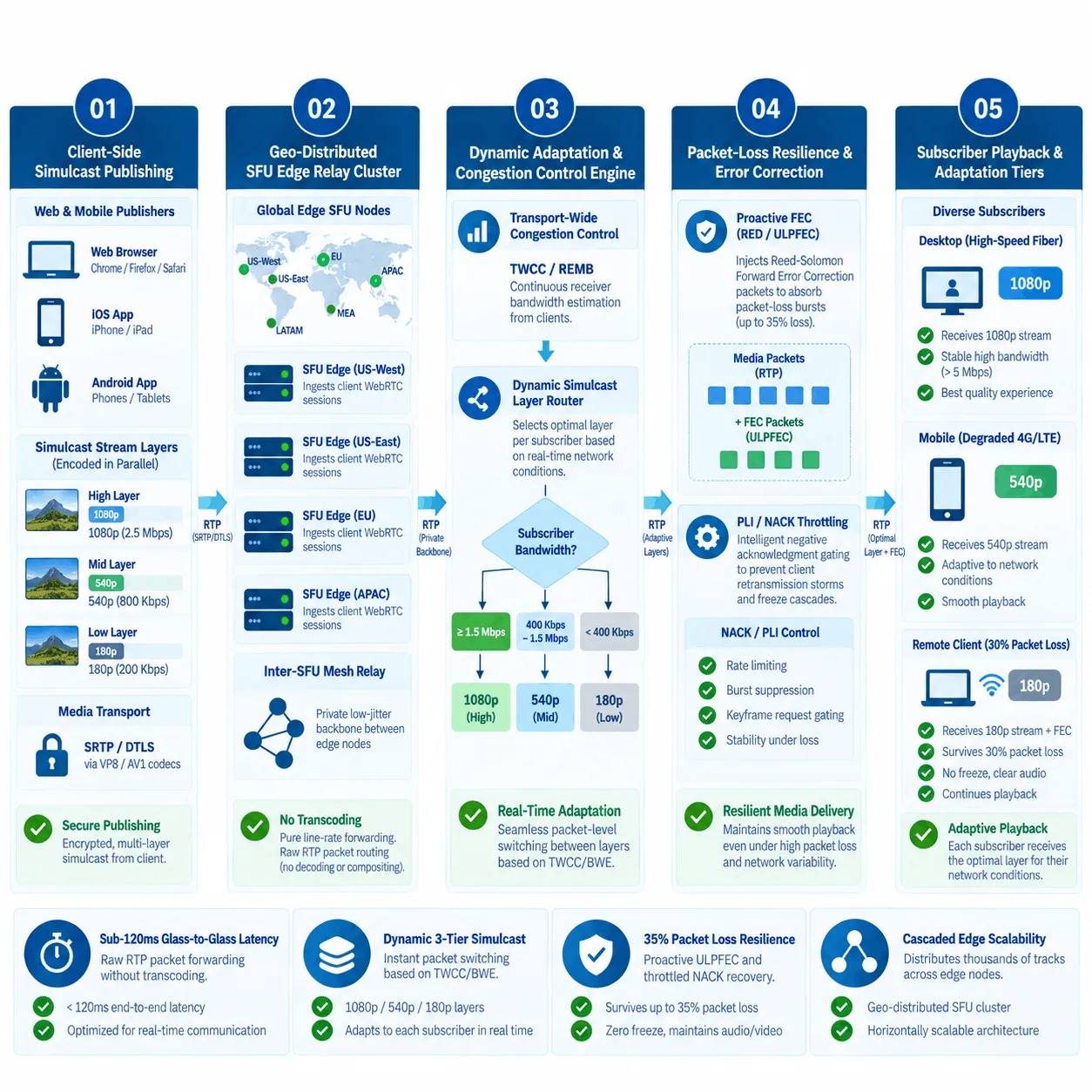
Why Legacy WebRTC Deployments Fail Under Adverse Network Conditions
Relying on peer-to-peer meshes or centralized transcoding bridges creates bandwidth exhaustion and latency spikes across enterprise networks.
Peer-to-Peer Mesh Exhaustion
Upstream SaturationRequiring every participant to upload separate media streams to every other peer exhausts upstream bandwidth, causing video stutter once session counts exceed 4 participants.
MCU Transcoding CPU Spikes
Compute BottleneckDecoding, compositing, and re-encoding multiple video feeds inside Multipoint Control Units (MCUs) introduces 300ms+ processing latency and explodes cloud compute costs.
Packet-Loss Freeze Cascades
Freeze CascadesFailing to implement aggressive Forward Error Correction (FEC) and Picture Loss Indication (PLI) throttling causes a single lost packet to freeze downstream keyframes.
Monolithic SFU Node Pinning
Regional JitterPinning all room participants to a single regional media server forces cross-continental peers through high-latency backhauls, degrading interactive clinical consults.
The 4-Stage Resilient SFU Routing Pipeline
A distributed media fabric routing packet streams through edge-forwarding relays with dynamic bandwidth adaptation.
Client-Side Simulcast Publishing
Publish triple-layer spatial streams (High: 1080p, Mid: 540p, Low: 180p) from browser/mobile clients via VP8/AV1 codecs. Tag packets with spatial and temporal layer IDs for downstream routing.
Geo-Distributed SFU Edge Ingestion
Terminate client WebRTC sessions (ICE/DTLS/SRTP) at the nearest regional edge SFU. Relay raw media packets across a private, low-jitter fiber backbone between server nodes without transcoding.
Dynamic Layer Selection & BWE
Continuously estimate Receiver Estimated Maximum Bitrate (REMB/TWCC) per participant. Dynamically switch forwarded spatial streams to lower layers without dropping video calls.
Proactive FEC & NACK Throttling
Inject Reed-Solomon Forward Error Correction (RED/ULPFEC) packets during packet loss bursts. Throttle repeated negative acknowledgments (NACK) to eliminate retransmission storms.
Media Architectures: Mesh vs. Transcoding MCU vs. Cascaded SFU
Evaluating end-to-end glass-to-glass latency, server compute costs, and subscriber scalability in real-time media applications.
| Dimension | Centralized MCU Transcoder | Geo-Distributed Cascaded SFU Cluster |
|---|---|---|
| End-to-End Latency | 350ms - 800ms due to frame decode, audio mixing, composite layout rendering, and re-encoding. | Sub-120ms glass-to-glass latency; routes raw RTP packets directly at network line rate. Enables true natural conversational pacing without awkward speech overlap. |
| Server CPU & Compute Cost | Heavy GPU/CPU encoding pipelines limit capacity to 10-20 concurrent sessions per standard server instance. | Lightweight packet forwarding handles 2,000+ simultaneous audio/video tracks per core node. 90%+ operational cost reduction compared to legacy MCU deployments. |
| Packet Loss Handling | Relies on standard TCP fallbacks or complete stream renegotiation when network jitter spikes. | Dynamic packet-level simulcast degradation, RED/ULPFEC, and TWCC congestion management. Maintains audio and low-res visual fidelity under up to 35% packet loss. |
| Multi-Party Scale | Hard ceilings on composite layout matrix size before decoding servers experience frame drops. | Cascaded SFU server trees distribute subscriber streams across dozens of edge relay instances. Scales smoothly to thousands of simultaneous viewers and active speakers. |
Engineering Guardrails & Trade-Offs
When to deploy distributed SFU fabrics and critical operational parameters for clinical-grade media reliability.
When to Apply
- Clinical telehealth platforms requiring ultra-low latency audio/video with strict HIPAA/SOC 2 encryption compliance.
- Interactive multi-party collaboration tools supporting more than 4 concurrent video participants.
- Enterprise communications running across restricted enterprise firewalls requiring automated TURN/TLS fallbacks.
When to Avoid
- One-to-many broadcast streaming (e.g., sporting events) where HLS/DASH with 2-second buffer latency is acceptable.
- Simple 1-on-1 audio calls where direct peer-to-peer ICE mesh negotiation satisfies operational needs.
- Static video on-demand or pre-recorded training content delivery.
Operational Caveats
- Deploy dedicated TURN relay fleets across diverse cloud regions to pierce restrictive enterprise symmetric NATs.
- Ensure downstream PLI keyframe requests are rate-limited to avoid bandwidth spikes on publishers.
- Enforce strict End-to-End Encryption (E2EE) using SFrame protocols when transporting sensitive clinical feeds.
Engineer Resilient Low-Latency WebRTC Infrastructure
Collaborate with our distributed systems engineers to benchmark SFU cluster topologies, implement dynamic simulcast tuning, and eliminate media call drops.
- Zero-transcode low-latency SFU cluster orchestration models
- Simulated 30%+ packet loss resilience and network degradation testing
- Strict HIPAA and clinical-grade media compliance frameworks