
FinTech Architecture • Treasury Engineering & Cross-Border Rails
Cross-Border Liquidity Rails: Programmatic FX Routing and Multi-Rail Clearing
Traditional cross-border settlement relies on fragmented correspondent banking chains that saddle corporate treasuries with opaque lifting fees, 48-hour settlement delays, and severe capital lockups in trapped pre-funded Nostro/Vostro balances.
This playbook establishes Codixon's reference architecture for modern multi-rail cross-border payments. By orchestrating native ISO 20022 messaging (pacs.008/pacs.009), real-time bilateral treasury netting, automated liquidity rebalancing, and programmatic corridor routing across local real-time payment (RTP) rails, enterprises bypass intermediary fee extraction and unlock atomic, intraday international settlements.
Why Legacy Correspondent Banking Degrades Margins
Routing international volume through multi-hop SWIFT chains introduces unpredictable intermediary deductions and traps liquidity.
Opaque Intermediary Fee Deductions
Fee LeakageIntermediary correspondent banks extract non-negotiated lifting fees from payment amounts mid-transit, delivering short payouts to payees and breaking commercial contract terms.
Trapped Nostro/Vostro Capital Drag
Capital InefficiencyMaintaining high cash balances across dozens of local bank accounts to support gross settlement creates liquidity deadweight and exposes operations to currency devaluation.
Legacy SWIFT MT Truncation
Remittance TruncationLegacy MT103 formats truncate payment remittance data and character sets, causing false-positive AML compliance alerts and manual operational investigation holds.
Asymmetric Batch Processing Delays
Settlement LagCrossing multiple sovereign time zones with batch cutoffs delays settlements over weekends and holidays, leaving cross-border trades exposed to unhedged FX volatility.
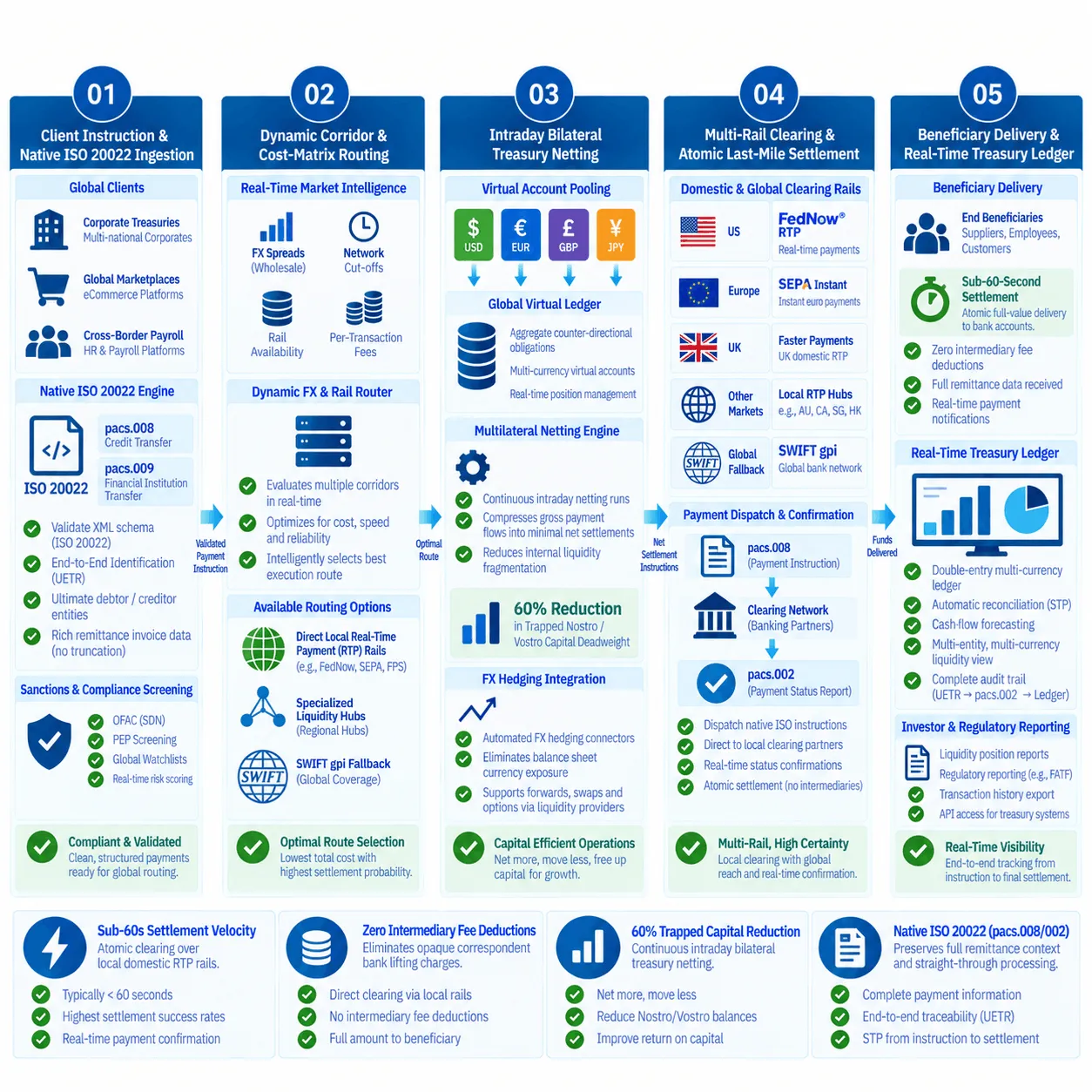
The 4-Stage Multi-Rail Routing & Clearing Fabric
An event-driven orchestration layer matching FX liquidity pools and dispatching native messages directly into destination clearing networks.
Native ISO 20022 Validation & Canonical Mapping
Ingest international payment instructions via ISO 20022 XML schemas (pacs.008). Validate structured end-to-end identification (UETR), ultimate debtor/creditor entities, and full remittance context.
Dynamic Corridor & Cost-Matrix Routing
Evaluate real-time corridor viability, FX spreads, network cut-off times, and per-rail processing costs. Choose dynamically between local RTP/FedNow/SEPA Instant rails, specialized liquidity hubs, or direct SWIFT gpi.
Intraday Bilateral Treasury Netting
Aggregate counter-directional cross-border obligations into localized virtual ledger buckets. Execute periodic multilateral netting runs to minimize gross physical cross-currency currency movements.
Atomic Last-Mile Real-Time Clearing
Dispatch instructions directly to destination domestic clearing networks via local banking partners or direct API rails. Receive instant pacs.002 status updates and confirm final delivery in seconds.
Cross-Border Settlement: Correspondent SWIFT vs. Programmatic Multi-Rail Routing
Evaluating settlement velocity, fee transparency, capital utilization, and remittance fidelity under high-volume treasury operations.
| Dimension | Legacy Correspondent Banking (SWIFT MT) | Programmatic Multi-Rail Clearing (ISO 20022) |
|---|---|---|
| Settlement Latency | 24 to 72 hours across correspondent hops, subject to localized clearing cut-offs and time zones. | Sub-60 seconds for bilateral netted corridors; under 5 minutes for direct-to-RTP rails. Accelerates working capital cycles and cash forecasting. |
| Fee Predictability | Opaque. Intermediary banks deduct variable correspondent lifting charges ($15 - $50 per hop). | Deterministic. Upfront programmatic wholesale FX spreads and fixed local domestic rail fees. Guarantees 100% full-value delivery to end beneficiaries. |
| Treasury Buffer Requirements | High idle Nostro balances parked in every destination country to ensure operational buffer. | Virtual account pooling and intraday continuous rebalancing reduce locked capital by up to 60%. Frees millions in trapped liquidity for enterprise treasury investment. |
| Remittance Data Richness | Severely limited field lengths; characters often stripped or corrupted during MT conversions. | Comprehensive structured XML payloads preserving invoices, tax IDs, and regulatory metadata. Enables automated straight-through reconciliation (STP) on arrival. |
Engineering Guardrails & Trade-Offs
Prerequisites and operational boundary constraints for orchestrating automated multi-rail FX routing platforms.
When to Apply
- Cross-border payment platforms, marketplaces, and global payroll providers handling high-frequency payouts.
- Corporate treasuries seeking to eliminate Nostro/Vostro capital lockup through automated bilateral netting.
- Financial institutions migrating to meet the mandated global transition to ISO 20022 payment standards.
When to Avoid
- Single-currency domestic payment systems with zero foreign exchange exposure.
- Low-frequency, bespoke international wire operations where volume cannot justify local banking partnerships.
- Exotic corridors where local real-time payment rails are legally or technologically unavailable.
Operational Caveats
- Implement real-time FX hedging connectors to eliminate balance-sheet exposure during intra-corridor settlement windows.
- Strictly validate local clearing character sets (e.g., SEPA vs. FedNow) to prevent edge parsing rejections.
- Every payment path must incorporate real-time sanctions screening (OFAC/PEP) before reaching outbound dispatch.
Build Modern Multi-Rail Cross-Border Clearing Infrastructure
Collaborate with our financial systems architects to design your ISO 20022 payment pipelines, automate multi-currency treasury netting, and eliminate correspondent fee drag.
- Native ISO 20022 XML parsing and validation engines
- Automated continuous bilateral netting and liquidity optimization models
- Strict compliance with global AML, sanctions, and financial messaging mandates