
Banking Architecture • Core Modernization & Ledger Migration
Decoupling Legacy Core Banking: Zero-Downtime Migration for High-Throughput Accounts
Relying on big-bang cutovers to replace mainframe core banking systems is an unacceptable systemic hazard. A single posting mismatch or dropped transactional journal during a hard migration cutover risks millions in regulatory sanctions, balance corruption, and immediate reputational failure.
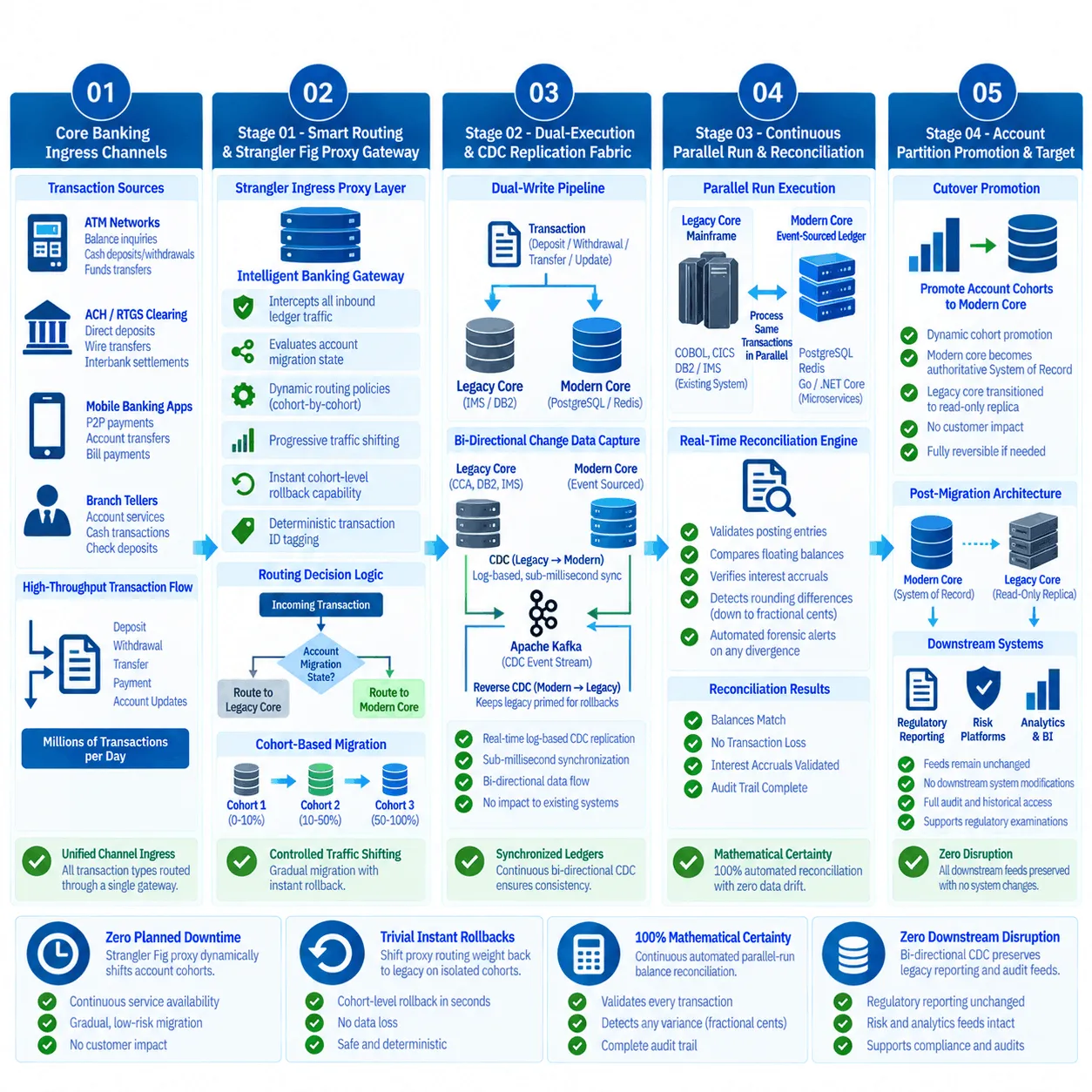
This playbook establishes Codixon's reference framework for modernizing tier-1 core banking platforms without scheduled downtime. By pairing Strangler Fig proxy gateways, parallel-run shadow double-entry ledgers, Change Data Capture (CDC) replication feeds, and automated microsecond balance reconciliations, financial institutions can progressively carve out transactional accounts while preserving operational continuity.
Why Big-Bang Core Replacements Trigger Catastrophic Outages
Migrating legacy COBOL and CICS ledger engines through monolithic weekend cutovers invites untracked balance drift and downstream settlement gridlock.
The Weekend Cutover Trap
Cutover ParalysisAssuming multi-terabyte ledger databases and millions of active customer profiles can be migrated, indexed, and balanced within a 48-hour maintenance window leads to failed deployments and forced rollbacks.
Silent Parallel-Run Divergence
Ledger DriftRunning shadow cores without deterministic transaction ordering causes race conditions on interest calculation and fee postings, generating unreconciled balance drifts.
Batch End-of-Day Lock contention
Lock ContentionDirectly querying legacy IMS or DB2 backends while legacy batch End-of-Day (EOD) jobs execute exhausts lock tables, degrading branch teller and ATM gateway response times.
Point-to-Point Integration Sprawl
Data CorruptionDozens of undocumented ancillary systems reading directly from mainframe disk arrays bypass new API abstraction proxies, creating silent data corruption.
The 4-Stage Zero-Downtime Core Strangler Pipeline
An incremental strangler architecture moving core ledger accounting from monolithic mainframes into event-sourced micro-ledgers.
Smart Routing & Ingress Proxying
Deploy an intelligent banking gateway proxy ahead of core ingestion channels (ATM, ACH, RTGS, Mobile). Direct incoming operations dynamically based on routing policy rules and account migration state.
Dual-Write & Change Data Capture Replay
Stream real-time transactions to the target modern ledger while continuously tailing mainframe database write-ahead logs via CDC. Replay state changes asynchronously to maintain sub-millisecond synchronization.
Continuous Automated Parallel Run
Execute real-time reconciliation engines comparing ledger entries, floating balances, and interest accruals between both systems. Automatically trigger forensic alerts for any sub-cent posting discrepancies.
Account Partition Promotion & Cutover
Flip the routing proxy authority account-by-account or cohort-by-cohort to make the modern ledger the system of record, switching the legacy mainframe core into an asynchronous read-only replica.
Core Modernization Paradigms: Big-Bang Migration vs. Incremental Strangler Fig
Benchmarking operational risk, balance validation certainty, and time-to-market across core banking transformation strategies.
| Dimension | Monolithic Big-Bang Cutover | Incremental Strangler Fig + Parallel Run |
|---|---|---|
| Operational Downtime | Demands planned system outages lasting 24-48 hours with severe risk of exceeding the weekend maintenance window. | Zero planned consumer-facing downtime; traffic migrations occur dynamically at the API routing proxy. Eliminates ATM and digital banking outage windows. |
| Rollback Viability | Near-impossible once production transaction processing begins on the new platform; point of no return is reached quickly. | Trivial per-account or per-cohort rollback by shifting proxy routing weight back to the legacy system of record. Limits failure blast radius to isolated account cohorts. |
| Balance Verification | Relies on pre-cutover static data checks, leaving real-time dynamic edge transactions unverified under live loads. | Dual-run verification engine matches live ledger balances continuously over months prior to formal cutover. Delivers 100% mathematical certainty on double-entry balances. |
| Downstream Disruption | All connected payment, regulatory reporting, and risk systems must cut over simultaneously. | Legacy CDC reverse feeds keep downstream legacy reporting systems populated without modification. Preserves existing compliance reporting unchanged. |
Engineering Guardrails & Trade-Offs
Core principles and operational boundary constraints for orchestrating parallel-run core banking modernizations.
When to Apply
- Tier-1 and Tier-2 banks operating mainframe core ledgers (COBOL, IMS, DB2) seeking to eliminate licensing overhead.
- Financial platforms where regulatory reporting mandates require an active continuous parallel-run verification period.
- High-velocity deposit and checking accounts requiring sub-10ms transactional processing and 99.999% uptime SLAs.
When to Avoid
- Early-stage fintech MVPs where operational ledger volume is small enough to permit brief scheduled migration windows.
- Non-transactional analytical data warehouses where batch ETL pipelines fulfill data freshness requirements.
- Low-frequency lending platforms without active debit card, ATM, or real-time payment network integrations.
Operational Caveats
- All dual-written messages must enforce deterministic transactional IDs to prevent out-of-order ledger replay.
- Maintain bi-directional CDC sync so any emergency rollback has an up-to-date mainframe ledger state.
- Automated reconciliation jobs must run continuously with immediate alerts on any penny-rounding divergence.
Modernize Core Banking Systems with Zero Downtime Risk
Collaborate with our financial systems architects to design your Strangler Fig strategy, validate parallel double-entry ledgers, and execute risk-managed account migrations.
- Production-grade Strangler Fig routing and dual-run reconciliation frameworks
- Zero-loss transactional change data capture (CDC) pipelines
- Strict compliance with Basel III, SOX, and regulatory audit mandates