
PropTech & Private Equity Architecture • Capital Engineering
Institutional Real Estate Syndication: Automating Multi-Tier Hurdle Waterfalls
Managing institutional real estate syndications via disconnected spreadsheets and manual accounting workflows creates severe compliance hazards and distribution lag. Bespoke LP/GP profit-sharing hurdles, irregular capital calls, and clawback calculations frequently result in balance reconciliations that miss reporting deadlines and violate LP agreements.
This playbook establishes Codixon's technical framework for programmatic private equity real estate operations. By pairing automated SEC Rule 506(c) accredited investor verification, deterministic European and American distribution waterfall computation engines, and event-sourced double-entry NAV portfolio ledgers, real estate sponsors achieve continuous auditability and instant, error-free quarterly distributions.
Why Spreadsheet-Based Syndication Distribution Breaks Down
Relying on manual calculation models across multi-tiered LP/GP hurdle structures introduces balance drift, regulatory scrutiny, and clawback litigation.
Formula Cell Drift & Calculation Errors
Calculation DriftSpreadsheet models calculating complex internal rates of return (IRR) across varied capital tranches inevitably develop copy-paste cell drift, misallocating promoted interest.
American vs. European Waterfall Drift
Clawback RiskFailing to strictly enforce deal-by-deal (American) versus whole-fund (European) hurdle priority rules leads to premature carried interest payments that trigger messy LP clawbacks.
Manual 506(c) Accreditation Gaps
Regulatory ExposureOnboarding accredited investors through static PDF forms without automated third-party verification creates regulatory vulnerabilities under SEC Rule 506(c) mandates.
Asymmetric NAV Reporting Latency
Reporting LagManual reconciliation between property asset managers and the syndication master fund delays quarterly Net Asset Value (NAV) reporting, frustrating institutional LPs.
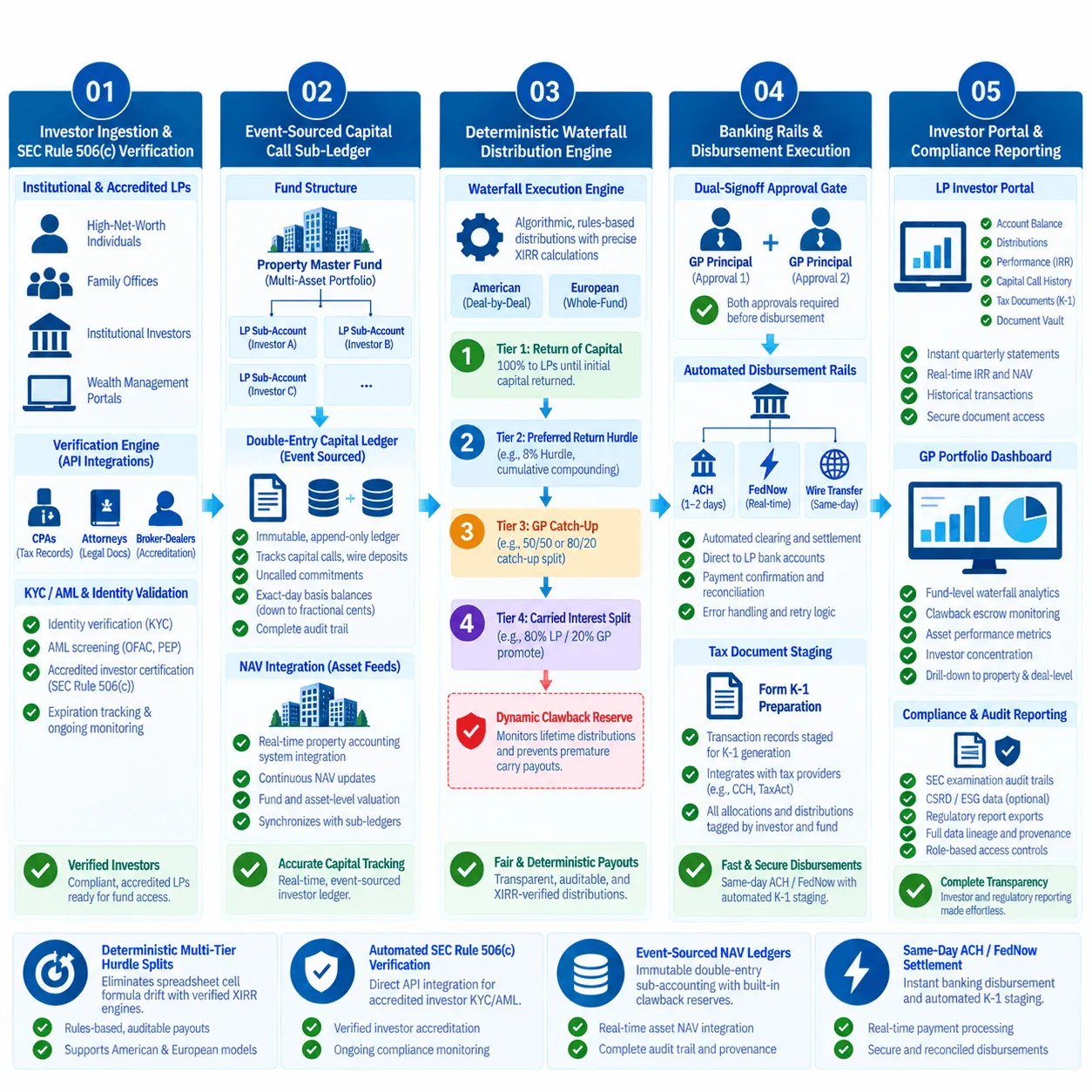
The 4-Stage Programmatic Syndication Fabric
A deterministic pipeline linking compliant investor verification, real-time property ledger feeds, and multi-tier payout allocations.
Automated SEC Rule 506(c) Ingestion
Ingest accredited investor credentials through API integrations with licensed broker-dealers and CPAs. Validate identity (KYC/AML) and verify tax-status documentation prior to issuing capital call notices.
Event-Sourced Capital Call Sub-Ledger
Record capital calls, wire deposits, and preferred return accruals onto an immutable, double-entry transactional ledger, guaranteeing accurate basis tracking down to fractional cents.
Deterministic Waterfall Distribution Engine
Execute multi-tier hurdle rules (Return of Capital, Preferred Return, Catch-up, and Carried Interest Splits) across either American or European structures using exact-day counting conventions.
Automated ACH/FedNow Clearing & Tax Prep
Disburse finalized distributions directly over banking rails while generating instant LP portal statements and staging raw transaction ledgers for automated Form K-1 tax generation.
Waterfall Management: Manual Financial Modeling vs. Programmatic Ledger Engines
Contrasting allocation accuracy, clawback protection, and investor auditability between spreadsheets and automated engines.
| Dimension | Manual Spreadsheet Models | Programmatic Double-Entry Engine |
|---|---|---|
| Mathematical Determinism | Prone to formula syntax errors, unversioned workbook updates, and manual override mistakes. | Unit-tested, immutable business rules calculating allocations down to the second using XIRR algorithms. Eliminates LP reconciliation disputes and discrepancies. |
| Clawback Prevention | Difficult to model dynamic cross-collateralization across concurrent multi-asset funds. | Built-in automated clawback reserves and escrow accounts modeled continuously against live portfolio NAV. Protects GPs from unexpected post-liquidation capital clawbacks. |
| Audit Trail & Compliance | Fragmented email threads, static PDF verification letters, and detached banking wire receipts. | End-to-end cryptographic audit trails capturing accreditation proofs, capital receipts, and distribution sign-offs. 100% SEC examination readiness with single-click reporting. |
| Quarterly Reporting Speed | 3 to 5 weeks of manual staff reconciliation after fiscal quarter close to finalize distributions. | Near-instantaneous NAV computation and distribution batch staging once property P&L feeds close. Significantly elevates sponsor credibility and investor retention. |
Engineering Guardrails & Trade-Offs
Key architectural prerequisites and operational boundaries for automating private equity real estate waterfalls.
When to Apply
- Real estate sponsors and syndicators managing multi-tier equity structures ($20M+ AUM) across complex LP pools.
- Private equity funds issuing frequent distributions that require exact day-count preferred return calculations.
- Syndications operating under SEC Rule 506(c) where verifiable accredited investor onboarding is mandatory.
When to Avoid
- Simple single-asset syndications with flat pro-rata profit splits and no tiered hurdle waterfalls.
- Friends-and-family syndicates under SEC Rule 506(b) where self-certification is permissible and reporting is minimal.
- Unregulated joint ventures with fewer than 3 total partners sharing direct capital accounts.
Operational Caveats
- Always codify whether preferred returns are cumulative, compounding, or simple interest directly in the rule set.
- Enforce dual-sign-off approval protocols on high-value outbound distribution wires before clearinghouse dispatch.
- Accreditation status verifications must carry clear expiration dates requiring automatic annual recertification.
Automate Your Multi-Tier Real Estate Syndication Waterfalls
Collaborate with our financial systems architects to model custom European and American waterfalls, integrate double-entry NAV ledgers, and automate LP distributions.
- Mathematically verified multi-tier waterfall allocation engines
- Strict compliance with SEC Rule 506(c) investor verification standards
- Zero-drift double-entry portfolio ledger architectures