
PropTech & Sustainability Architecture • Industrial BMS Modernization
Smart Building BMS Integration: Bridging BACnet/Modbus to Automated ESG Accounting
Commercial real estate portfolios face tightening corporate sustainability reporting mandates and volatile grid peak-demand charges. Yet, property telemetry remains trapped inside legacy building management systems using isolated BACnet and Modbus serial protocols, forcing property managers into retrospective utility-bill spreadsheet estimations.
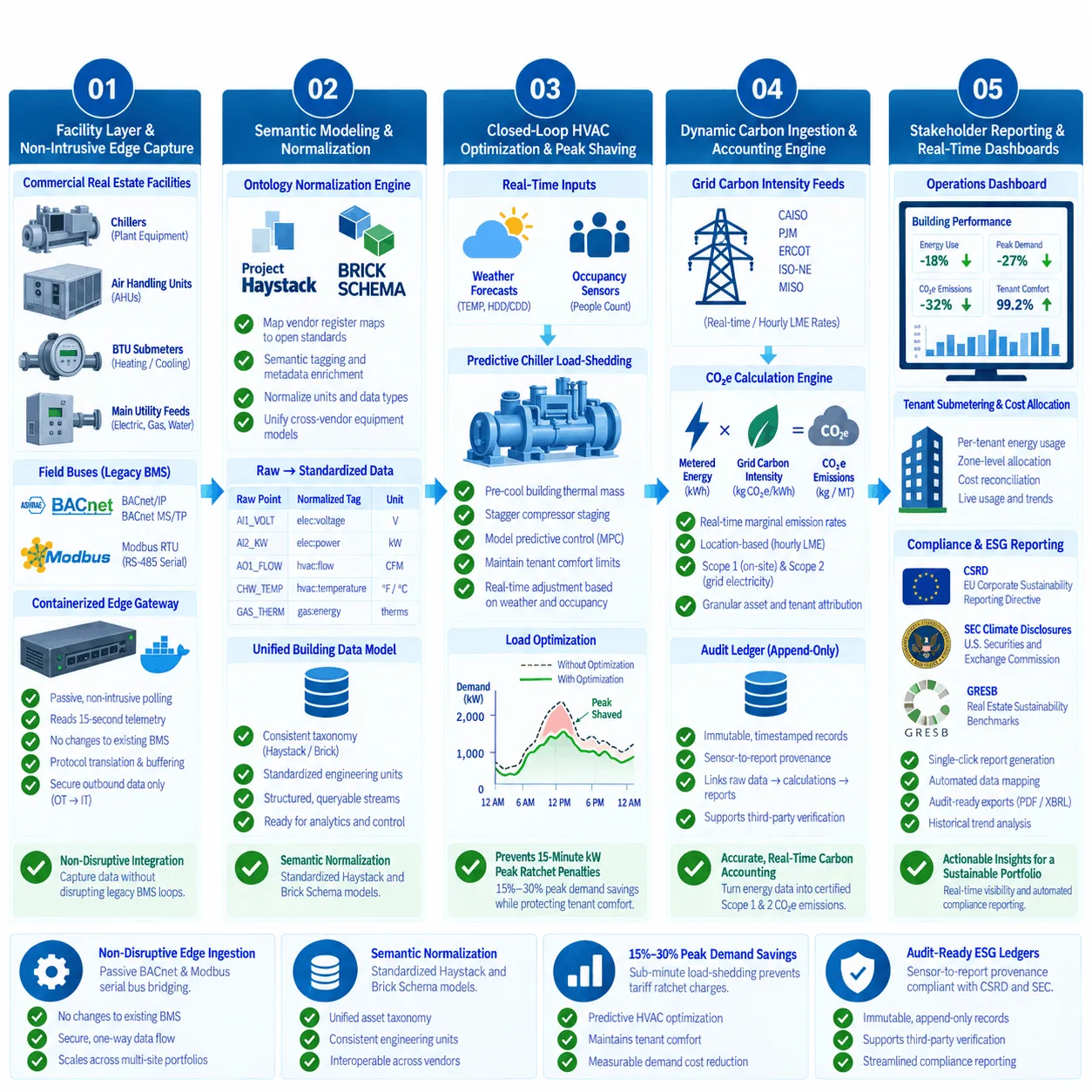
This playbook establishes Codixon's engineering framework for modern property telemetry. By deploying non-intrusive edge bridges, normalized Haystack/Brick schema ontologies, dynamic HVAC chiller load-shedding control loops, and auditable Scope 1 and Scope 2 emission pipelines, real estate operators transform static facilities into responsive energy assets ready for rigorous ESG compliance.
Why Legacy Facility Data Fails Modern ESG Scrutiny
Relying on quarterly utility invoices and disconnected field sensors produces unverified carbon claims and missed demand-response revenue.
The Utility Bill Reconciliation Lag
Reporting BlindspotDeriving corporate Scope 1 and Scope 2 emissions from end-of-month electric and gas invoices hides operational waste for 45 to 60 days, precluding active equipment remediation.
BMS Protocol Fragmentation
Protocol Lock-inDisparate submeters, chillers, and air-handling units communicating over RS-485 serial networks (BACnet MS/TP, Modbus RTU) remain siloed from central cloud infrastructure.
Peak Demand Ratchet Penalties
Tariff EscalationLacking sub-minute power metering, simultaneous chiller starts trigger massive 15-minute kW spikes that lock in inflated utility capacity ratchet charges for an entire billing year.
Unverified Carbon Accounting Data
Audit VulnerabilityAggregating uncalibrated sensor metrics without immutable audit trails invites greenwashing accusations and regulatory fines under CSRD and SEC climate disclosure rules.
The 4-Stage Property Telemetry & Carbon Accounting Fabric
A deterministic pipeline transforming field-level building bus telemetry into certified, investment-grade GHG protocol ledgers.
Non-Intrusive Edge Bus Bridging
Attach containerized edge gateways to existing BACnet/IP and RS-485 serial networks. Read high-frequency telemetry from BTU meters, VAV boxes, and main utility feeds using passive polling without disrupting legacy BMS loops.
Haystack & Brick Semantic Tagging
Map proprietary vendor register addresses to standardized Project Haystack and Brick Schema models. Convert raw voltage and flow rates into structured, contextual energy telemetry streams with uniform engineering units.
Predictive HVAC Load-Shedding
Execute closed-loop edge automation using weather forecasts and occupancy trends. Pre-cool thermal mass and stagger chiller staging to flatten electric peak-demand spikes while maintaining tenant comfort standards.
Emission Factor Ledger & GHG Certification
Multiply metered kWh and therm consumption against dynamic, locational marginal emission factors. Persist carbon equivalents ($CO_2e$) in an immutable audit ledger for single-click ESG reporting.
Building Energy Management: Utility Invoicing vs. Streaming Edge Telematics
Evaluating reporting fidelity, energy optimization potential, and audit verifiability across portfolio management models.
| Dimension | Retrospective Utility Invoices | Streaming Edge BMS + Automated ESG Ledger |
|---|---|---|
| Telemetry Granularity | Aggregated 30-day billing summaries with zero visibility into asset-level energy consumption. | Continuous 15-second submeter and sensor streams mapped by equipment, floor, and tenant zone. Enables precise sub-tenant energy allocation and billing. |
| Demand Charge Mitigation | None. Facilities discover peak demand threshold breaches weeks after they incur the penalty. | Automated sub-minute load-shedding trims non-critical loads before 15-minute demand peaks occur. Lowers commercial electric bills by 15% to 30% annually. |
| GHG Calculation Accuracy | Coarse national grid averages applied across static quarterly totals, distorting carbon calculations. | Correlated against hourly marginal emission rates from local grid ISOs (e.g., PJM, CAISO, ERCOT). Generates verifiable data compliant with GHG Protocol Scope 2 guidance. |
| Audit Verification Speed | Weeks of manual spreadsheet reconciliation vulnerable to transcription errors and omissions. | Cryptographically verifiable ledger records with sensor-to-report provenance for third-party assurance. Passes external CSRD, SEC, and GRESB audits with zero manual compilation. |
Engineering Guardrails & Trade-Offs
Operational prerequisites and architectural boundaries for safe building integration and automated carbon tracking.
When to Apply
- Commercial office portfolios, data centers, and industrial facilities facing mandatory CSRD or SEC climate disclosure.
- Properties facing punitive utility demand charges that can be reduced through automated HVAC load shifting.
- Enterprise corporate campuses seeking real-time tenant energy submetering and automated cost-center allocations.
When to Avoid
- Small stand-alone retail units with packaged rooftop AC units lacking digital BMS controller interfaces.
- Triple-net leased single-tenant properties where landlords have zero technical access to utility metering infrastructure.
- Scenarios requiring only basic annual Scope 1 and Scope 2 estimates where utility bill aggregation is sufficient.
Operational Caveats
- Edge write commands must enforce hard thermostat override limits to prevent tenant comfort breaches during load-shedding.
- Always isolate edge gateway field network interfaces from corporate IT networks using dual-homed physical firewalls.
- Hourly grid carbon intensity feeds must include fallback regional static baselines in case of ISO API outages.
Bridge Facility BMS Infrastructure to Automated ESG Ledgers
Collaborate with our facility and IoT systems architects to deploy non-intrusive edge bridges, optimize chiller loads, and automate certified Scope 1 & 2 carbon accounting.
- Non-disruptive BACnet, Modbus, and LonWorks edge integration patterns
- Automated peak-shaving control loops reducing annual utility demand tariffs
- Audit-ready GHG Protocol Scope 1 & 2 ledger reference architectures