
Life Sciences & Enterprise EdTech • Regulatory Compliance Architecture
Multi-Tenant Corporate LMS Architecture: Scalable xAPI Ingestion and GxP Compliance
Enterprises operating under FDA 21 CFR Part 11 and EU Annex 11 (GxP) mandates face strict regulatory scrutiny over workforce training records. Outdated corporate LMS deployments frequently suffer data loss during high-volume training cutoffs, exhibit multi-tenant cross-contamination vulnerabilities, and rely on manual HR spreadsheet tracking that leads to lapsed employee qualifications and severe audit citations.
This playbook establishes Codixon's reference architecture for mission-critical enterprise LMS platforms. By pairing an event-driven xAPI (Experience API) Learning Record Store (LRS) running on distributed streaming pipelines with schema-isolated multi-tenant data stores, automated SCIM-driven HRIS synchronization, and cryptographically verified recertification state machines, organizations guarantee immutable audit trails and uninterrupted compliance across global business units.
Why Generic Enterprise LMS Platforms Fail GxP Audits
Synchronous state tracking, porous tenancy boundaries, and manual identity provisioning expose life sciences and regulated firms to catastrophic regulatory penalties.
21 CFR Part 11 Audit Trail Failures
Audit FindingStoring electronic signatures and course completion timestamps in mutable database tables without immutable append-only ledgers triggers critical FDA Form 483 inspection citations.
LRS Ingestion Queue Saturation
Telemetry DropSynchronous REST endpoints ingesting fine-grained xAPI activity statements (video ticks, quiz latencies) crash under concurrent shift-change training spikes, dropping learner progress records.
HRIS Directory Synchronization Drift
Qualification LagRelying on scheduled nightly batch CSV uploads to sync employee titles leaves a dangerous lag window where transferred staff perform regulated duties without required certifications.
Tenant Privilege Escalation
Data ContaminationSoft multi-tenancy models using shared database schemas and application-layer filters risk leaking validated SOP documentation and training records across subsidiaries or clinical trial sponsors.
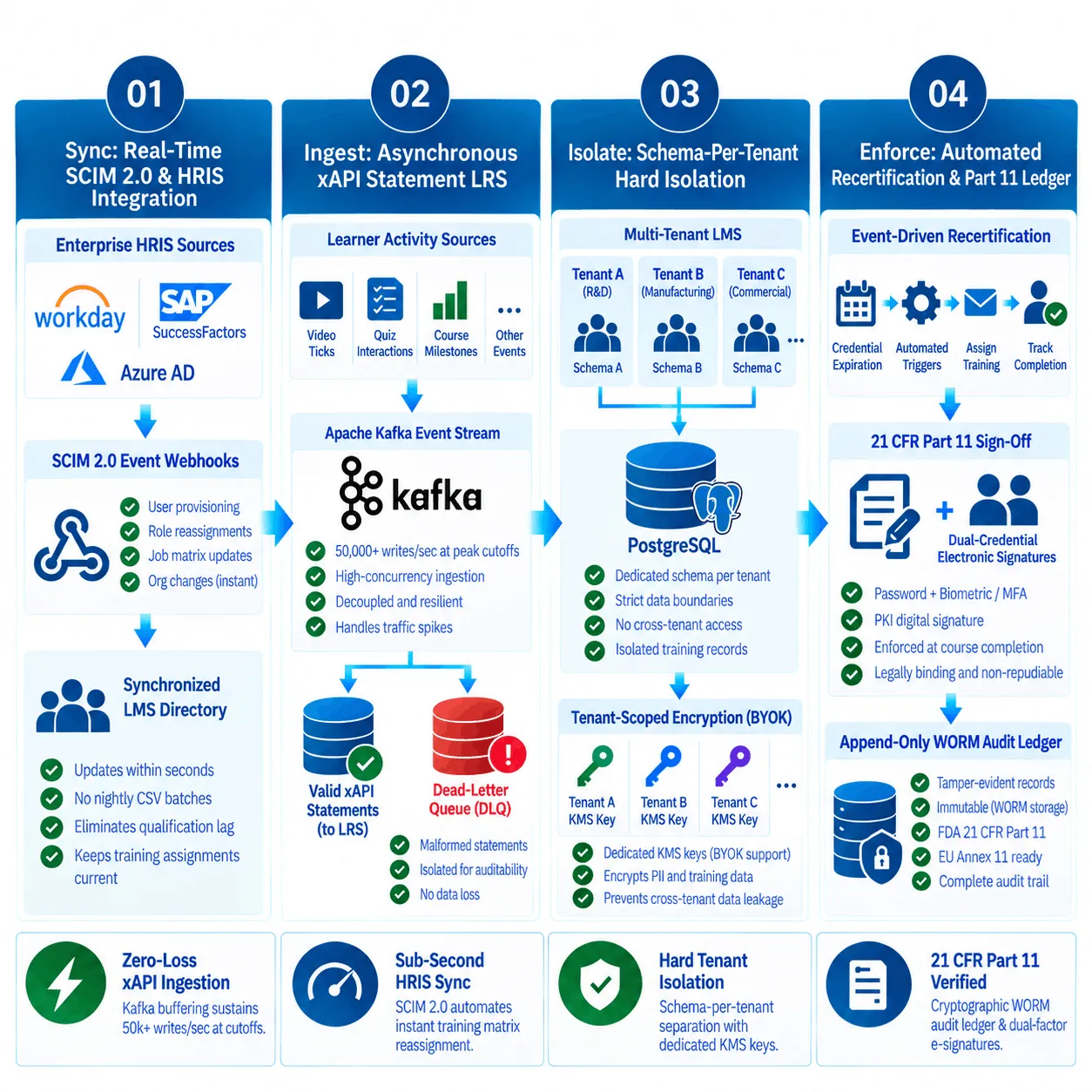
The 4-Stage GxP Compliance & Telemetry Fabric
A deterministic pipeline orchestrating streaming learning telematics, real-time organizational directory sync, and automated recertification loops.
Real-Time SCIM 2.0 & HRIS Integration
Stream organizational changes, job matrix transitions, and role assignments in real time from Workday, SAP SuccessFactors, or Azure AD via SCIM 2.0 webhooks, immediately updating required training matrices.
Decoupled Asynchronous xAPI Statement LRS
Buffer millions of high-frequency xAPI statements through Apache Kafka before writing to an append-only time-series data store, guaranteeing zero statement loss during concurrent enterprise training deadlines.
Schema-Per-Tenant Hard Isolation
Enforce tenant boundaries using dedicated PostgreSQL database schemas and tenant-scoped KMS encryption keys, preventing cross-tenant data leakage while simplifying tenant-specific compliance archiving.
Automated Recertification & Digital Signature Ledger
Drive role-based recertification cycles via event-driven state machines. Capture dual-factor PKI electronic signatures complying strictly with 21 CFR Part 11 requirements upon course completion.
Corporate Training Engines: Standard Monolithic LMS vs. GxP Event-Driven Architecture
Evaluating regulatory auditability, telemetry ingestion throughput, and tenant security across training platforms.
| Dimension | Standard Enterprise LMS | Event-Driven GxP Compliance LMS |
|---|---|---|
| Audit Trail Integrity | Mutable database records; timestamps and states can be modified by database administrators. | Append-only write-once cryptographic ledger with non-repudiation and complete revision history. Meets strict FDA 21 CFR Part 11 and EU Annex 11 validation expectations. |
| xAPI / Telemetry Throughput | Synchronous REST calls directly to web application tier, choking under heavy concurrent traffic. | Distributed Kafka message brokers decoupling statement ingestion from persistent storage writes. Sustains 50,000+ statement writes/sec during global regulatory deadlines. |
| Directory Synchronization | Scheduled daily or weekly batch CSV imports with manual conflict resolution. | Event-driven SCIM 2.0 streaming that reassigns learning paths within seconds of an employee role change. Eliminates regulatory compliance gaps caused by employee job title changes. |
| Multi-Tenant Boundaries | Logical filtering by TenantID on a single shared schema; high risk of query-level leakage. | Physical database or schema separation with isolated tenant encryption keys (BYOK support). Guarantees regulatory inspection boundaries across corporate divisions. |
Engineering Guardrails & Trade-Offs
Architectural boundary conditions and regulatory requirements when engineering GxP-validated learning platforms.
When to Apply
- Life sciences, biotechnology, medical device, and aerospace enterprises operating under strict GxP and ISO quality standards.
- Global conglomerates requiring secure multi-tenant isolation across subsidiaries, defense divisions, or joint ventures.
- Organizations migrating away from legacy SCORM 1.2 platforms to capture detailed learning analytics without losing regulatory validation.
When to Avoid
- Unregulated small-to-medium businesses where standard off-the-shelf SaaS LMS solutions meet all compliance needs.
- Consumer-facing digital course platforms or hobbyist learning hubs with zero formal audit verification requirements.
- Internal knowledge bases that do not require mandatory recertification workflows or legal non-repudiation.
Operational Caveats
- Computer System Validation (CSV / CSA) documentation must be updated and formally approved before deploying schema changes.
- Ensure electronic signature workflows enforce re-authentication at the exact point of course completion.
- Implement dead-letter queues (DLQ) on the xAPI Kafka consumer to preserve malformed statements for forensic audit inspection.
Architect Validated GxP Learning Platforms
Collaborate with our enterprise software architects to build high-throughput xAPI Learning Record Stores, integrate real-time SCIM directory sync, and achieve 21 CFR Part 11 validation readiness.
- 21 CFR Part 11 and EU Annex 11 compliant append-only audit trail engineering
- High-throughput Kafka-backed xAPI statement ingestion pipelines
- Real-time SCIM 2.0 HRIS directory synchronization and qualification matrix management