
Travel & Hospitality Architecture • High-Throughput Distribution Systems
High-Throughput GDS Caching: Slashing Airline Look-to-Book Fees with Smart Caches
Online Travel Agencies (OTAs), meta-search aggregators, and corporate booking engines face crushing economic penalties due to astronomical Look-to-Book (L2B) ratios. Ingesting millions of uncommitted flight search queries against Sabre, Amadeus, and direct IATA NDC pipes triggers severe upstream carrier query penalty fees, while naive static caching causes seat availability drift and costly checkout booking failures.
This playbook establishes Codixon's technical architecture for intelligent multi-tier GDS cache fabrics. By combining dynamic Time-to-Live (TTL) decay algorithms based on departure proximity, probabilistic availability recalculation models, and pre-booking inventory verification hooks across Sabre, Amadeus, and NDC APIs, travel platforms slash upstream GDS query overhead by up to 85% while maintaining zero-inventory-mismatch checkout guarantees.
Why Naive GDS Integration Cripples Travel Profitability
Passthrough API querying and fixed-time caching expose digital travel platforms to massive financial penalties and booking cart abandonment.
Astronomical Look-to-Book Penalty Fees
Financial PenaltyExceeding contracted GDS Look-to-Book thresholds (often exceeding 5,000:1) triggers severe commercial surcharge penalties from Sabre and Amadeus on uncommitted search queries.
Stale Inventory Checkout Rejections
Booking FailureServing flight itineraries from static, long-lived caches results in booking failures when seats or fare buckets are sold out upstream, causing immediate traveler drop-off.
IATA NDC Gateway Throttling
Rate LimitingHammering direct airline New Distribution Capability (NDC) XML/JSON endpoints with raw metasearch traffic causes upstream rate-limiting and connection drops.
Hot-Route Cache Invalidation Stamps
Cache StampedeEvicting entire origin-destination (OD) fare caches uniformly triggers thundering herd query spikes against upstream GDS backends during peak promotional campaigns.
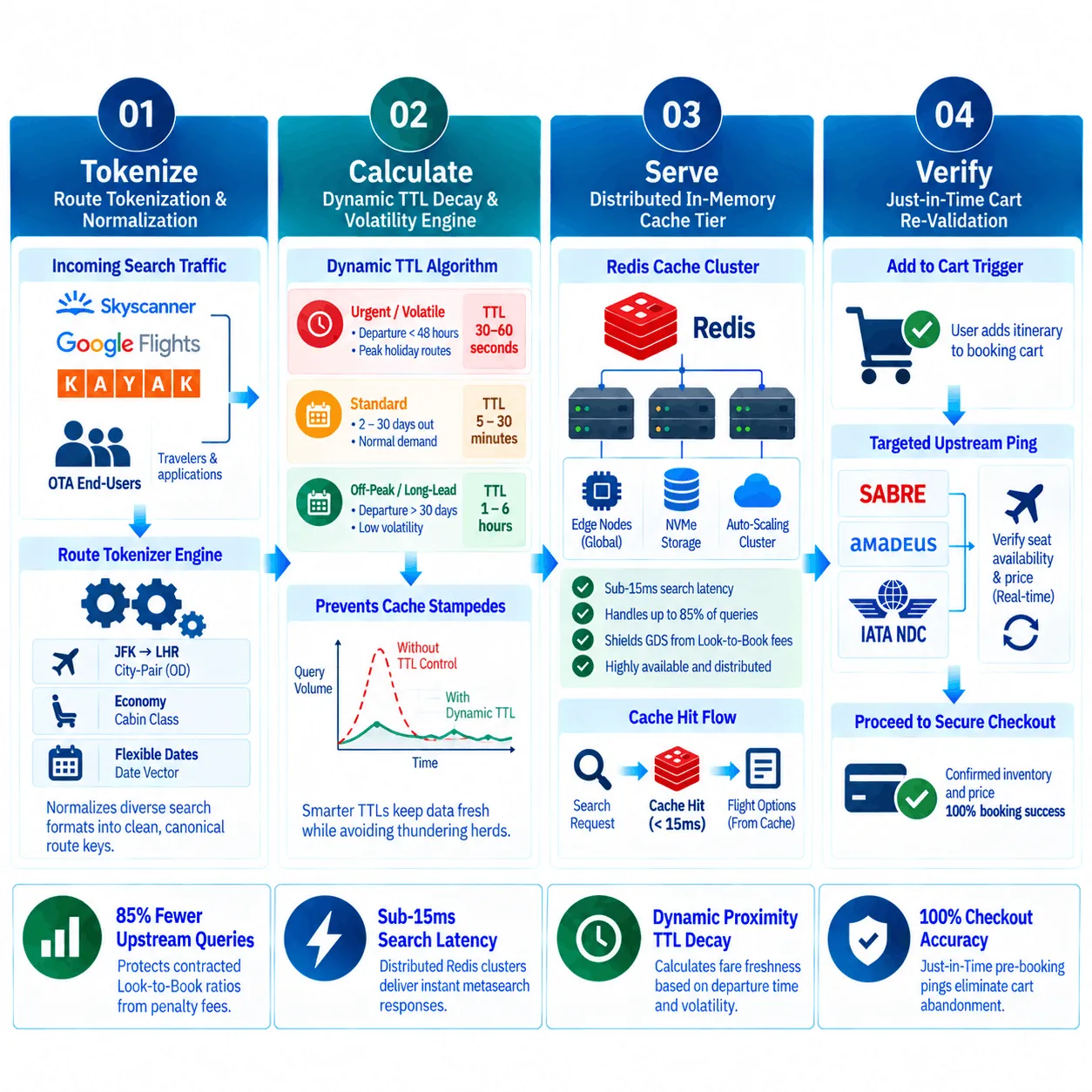
The 4-Stage Smart GDS Caching Fabric
A deterministic pipeline combining flight route tokenization, dynamic TTL decay engines, and proactive inventory verification.
Route Tokenization & Normalization
Tokenize incoming flight search requests into normalized City-Pair Origin-Destination (OD) keys, cabin class identifiers, and flexible date vectors. Decouple front-end metasearch queries from proprietary upstream GDS payload structures.
Dynamic TTL Decay & Volatility Modeling
Dynamically compute cache expiration lifetimes. Fares departing in under 48 hours or high-volatility holiday routes receive sub-minute TTLs, whereas long-lead off-peak routes carry extended multi-hour caching windows.
Distributed In-Memory Tiering
Serve sub-15ms search results from distributed Redis memory clusters backed by pre-computed NVMe fare indexes, absorbing high-frequency metasearch robot spikes without touching upstream GDS or NDC pipes.
Asynchronous Just-in-Time Cart Re-Validation
Trigger an instant upstream GDS/NDC single-seat inventory ping the millisecond a user selects a flight into their cart, confirming price and availability before payment capture to ensure 100% booking success.
Travel Distribution: Direct GDS Passthrough vs. Smart Caching Fabrics
Evaluating infrastructure costs, look-to-book performance, and checkout success rates across distribution architectures.
| Dimension | Direct GDS / NDC Passthrough | Dynamic TTL Smart Caching Fabric |
|---|---|---|
| GDS Look-to-Book Overhead | Exorbitant penalty fees incurred when search-to-booking ratios exceed upstream commercial tiers. | Up to 85% reduction in upstream queries, preserving contracted Look-to-Book SLA ratios. Transforms variable API penalty overhead into fixed, predictable cloud costs. |
| Search Response Latency | 1,500ms to 4,000ms dependent on legacy GDS mainframe response and third-party roundtrips. | Sub-50ms cache hits served directly from distributed edge memory tiers. Dramatically lifts metasearch referral ranking and front-end conversion rates. |
| Inventory Accuracy at Checkout | High at search time, but vulnerable to cart drops if user deliberates before purchase. | Guaranteed 100% accuracy via automated Just-in-Time (JIT) pre-checkout validation hooks. Eliminates post-payment cancellation and customer support refund loops. |
| Metasearch Spike Resilience | Upstream rate-limit throttling and service dropouts during sudden metasearch crawler spikes. | Scalable Redis cluster and edge proxies absorbing hundreds of thousands of concurrent RPM. Protects core transaction availability from rogue scrapers. |
Engineering Guardrails & Trade-Offs
Architectural rules and operational requirements for implementing dynamic GDS inventory caches.
When to Apply
- Online Travel Agencies (OTAs) and booking engines handling over 500,000 flight searches daily.
- Travel platforms receiving heavy traffic from metasearch engines (e.g., Skyscanner, Google Flights, Kayak).
- Distributors integrating direct airline IATA NDC connections with strict per-second API query ceilings.
When to Avoid
- Low-volume corporate travel portals processing fewer than 1,000 monthly bookings with low search-to-book ratios.
- Charter flight operators managing private fleet inventory directly inside internal bespoke databases.
- Scenarios where upstream distribution agreements explicitly forbid intermediate caching of fare pricing.
Operational Caveats
- Always implement an automatic circuit breaker that bypasses the cache if upstream price volatility reaches critical thresholds.
- Never skip the Just-in-Time (JIT) pre-checkout verification ping before authorization charges are committed.
- Maintain strict partition segregation between public web cache clusters and corporate negotiated contract fare caches.
Slash Upstream GDS Fees and Accelerate Search Velocity
Collaborate with our travel distribution architects to engineer dynamic TTL caching fabrics, integrate IATA NDC pipes, and eliminate inventory mismatch cart failures.
- Dynamic departure-proximity TTL decay algorithms preventing fare drift
- Up to 85% reduction in upstream Sabre, Amadeus, and NDC query volumes
- Zero-inventory-mismatch guarantees via Just-in-Time checkout verification