
Travel & Mobile Systems Architecture • Resilient Edge Applications
Offline-First Travel Architecture: Keeping Mobile Itineraries Resilient in Off-Grid Zones
Luxury adventure travelers and expedition groups regularly traverse remote regions with zero cellular coverage—from Antarctic cruises to high-altitude treks. Mobile travel apps engineered around conventional web-first assumptions crash, clear cached vouchers, or display empty white screens the moment connectivity drops, stranding travelers without boarding documents, emergency contacts, or navigable waypoints.
This playbook establishes Codixon's engineering architecture for offline-first native mobile platforms. By coupling encrypted embedded SQLite storage with mathematical delta-sync algorithms, binary protocol serialization, and localized Mapbox vector tile caching, adventure operators ensure full bi-directional itinerary updates, flawless voucher rendering, and reliable waypoint navigation in completely disconnected environments.
Why Standard Web-Wrapped Travel Apps Collapse in Remote Field Operations
Treating mobile clients as thin browsers over REST APIs triggers catastrophic user experience failures in off-grid destinations.
Session Invalidation Lockouts
Auth LockoutExpiring OAuth access tokens while a traveler is deep off-grid locks the mobile client into a forced login screen that cannot resolve without an internet connection.
Ephemeral Web Cache Eviction
Voucher LossRelying on standard mobile browser caches or raw HTTP cache headers allows operating systems to silently flush critical travel vouchers to reclaim system disk space.
Monolithic Payload Overfetch
Sync TimeoutForcing devices to download the entire 14-day itinerary JSON bundle on reconnect exhausts spotty satellite connection bandwidth and times out repeatedly.
Blank-Screen Vector Tile Drops
Navigation BlindFailing to pre-bundle boundary-clipped vector tiles forces map rendering views into empty grid canvases the moment a user leaves cellular roaming range.
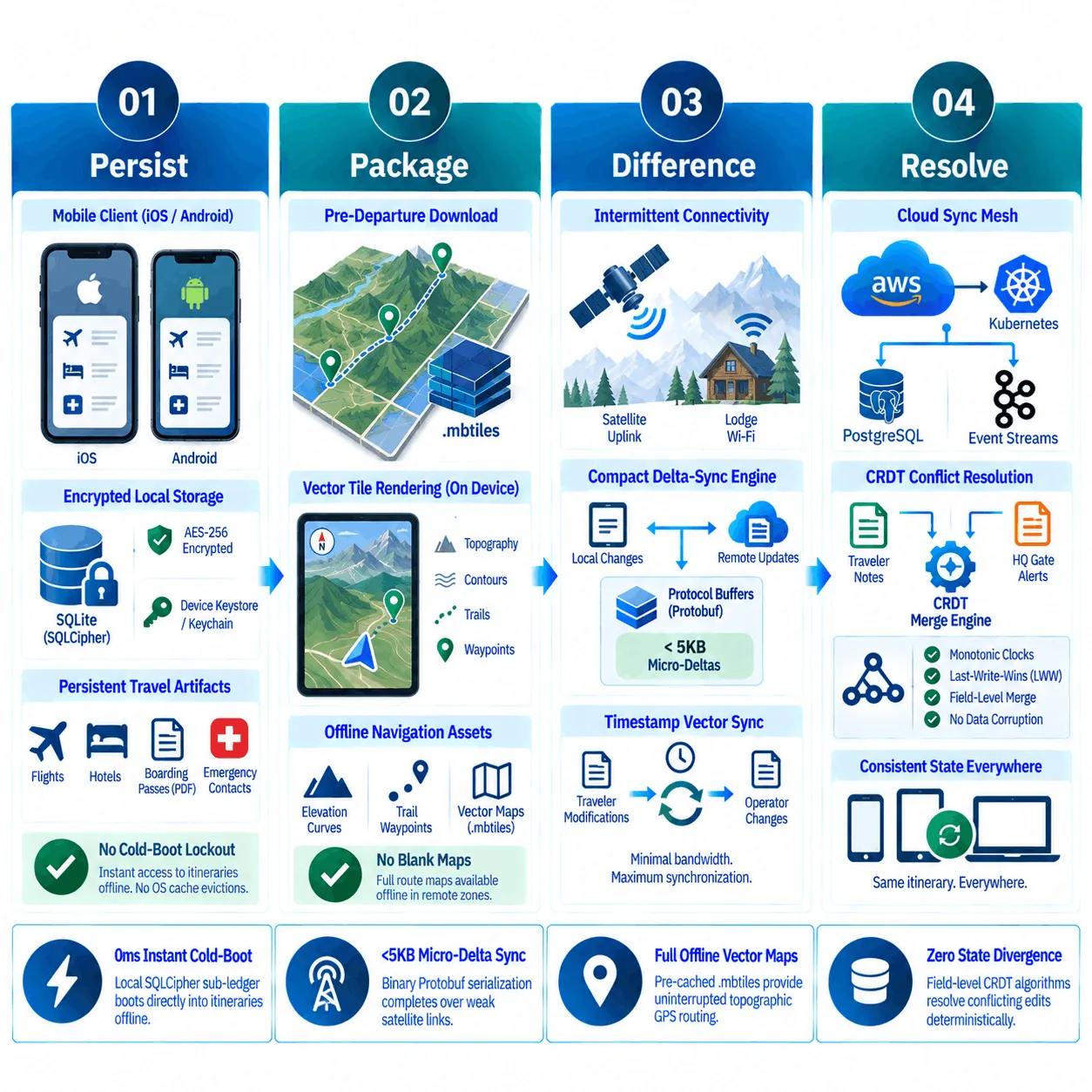
The 4-Stage Offline-First Client-Cloud Synchronization Fabric
A deterministic pipeline orchestrating hardened edge storage, delta-sync state reconciliation, and pre-cached geospatial data planes.
Encrypted Client SQLite Sub-Ledger
Treat local client storage as the absolute source of truth. Persist multi-segment flight details, hotel confirmations, emergency medical contacts, and PDF boarding vouchers in an AES-256 encrypted local SQLite database (SQLCipher).
GeoJSON & Vector Map Tile Pre-Caching
Bundle polygon-bounded vector map tiles (.mbtiles) along the planned itinerary route before departure. Store topography, elevation curves, and critical trail waypoints natively on the device filesystem.
Compact Timestamp-Vector Delta Sync
When intermittent satellite or hotel Wi-Fi flickers on, exchange only micro-deltas using Protocol Buffers (Protobuf). Synchronize localized modifications and upstream schedule revisions without re-downloading unchanged itinerary segments.
Conflict-Free Replicated Resolution (CRDT)
Resolve concurrent modifications—such as traveler dietary updates on-device versus operator gate change announcements from headquarters—using field-level Last-Write-Wins and CRDT merge algorithms.
Travel Mobile Architectures: Online-First REST vs. True Offline-First Core
Evaluating resilience, sync overhead, and operational survivability across remote field environments.
| Dimension | Online-First Hybrid / REST | Offline-First Native SQLite + CRDT |
|---|---|---|
| Cold-Boot Offline Behavior | Displays loading spinners, network error dialogues, or kicks user back to an unreachable login prompt. | Immediate 0ms boot directly into fully populated itineraries, vouchers, and emergency documents. Delivers absolute reliability for travelers in mountain or maritime zones. |
| Network Bandwidth Consumption | Downloads uncompressed full-itinerary JSON blobs (2MB to 10MB) on every screen focus. | Exchanges compressed Protobuf binary deltas (<5KB), ensuring sync completes over weak satellite uplinks. Reduces satellite roaming data costs for travelers and operators. |
| Conflict Handling | Coarse object overwrites that wipe out local notes or silently drop remote tour updates. | Deterministic field-level state reconciliation backed by vector clocks and transactional logs. Eliminates itinerary corruption and state divergence. |
| Offline Map Navigation | Raster tiles that fail to load, showing broken image placeholders when offline. | Native Mapbox vector styling rendered locally from compressed SQLite tile packs. Enables reliable real-time offline GPS tracking against pre-rendered topographic contours. |
Engineering Guardrails & Trade-Offs
Architectural boundaries and operational safeguards for deploying off-grid mobile travel experiences.
When to Apply
- Expedition travel operators, adventure cruise lines, and remote safari guides operating beyond reliable mobile networks.
- Luxury bespoke travel apps serving high-net-worth clients requiring instantaneous access to bookings and documents.
- Field guide dispatch and emergency evacuation apps operating in national parks and maritime corridors.
When to Avoid
- Simple domestic flight aggregators where travelers consistently operate in major metropolitan 5G networks.
- Web-only booking portals with no accompanying native iOS or Android mobile application codebase.
- Ticketing apps requiring continuous real-time dynamic barcode rotation against active anti-fraud servers.
Operational Caveats
- Never store plaintext authentication credentials; leverage secure OS hardware keystores (iOS Keychain / Android Keystore).
- Enforce a pre-trip download checklist before departure to guarantee all vector map tiles and PDF vouchers are cached.
- Implement monotonic logical clocks on the server to prevent device clock-tampering from skewing sync priority.
Architect Resilient Offline-First Travel Platforms
Collaborate with our mobile systems architects to build crash-resilient embedded SQLite engines, integrate low-bandwidth delta-sync algorithms, and pre-cache vector navigation maps for off-grid operations.
- Zero-downtime offline-first architectures backed by SQLCipher
- Low-overhead Protobuf delta synchronization for weak satellite connections
- Vector map caching (.mbtiles) for seamless GPS navigation in remote destinations