
Life Sciences Architecture • Regulatory Engineering
21 CFR Part 11 & GxP Compliance in Modern Cloud-Native SaaS
Deploying continuous delivery and multi-tenant architectures into FDA-regulated clinical trials and pharmaceutical manufacturing creates an immediate compliance hazard. Standard agile rollouts, mutable relational tables, and basic SSO logins fail statutory inspections under 21 CFR Part 11 and EU Annex 11.
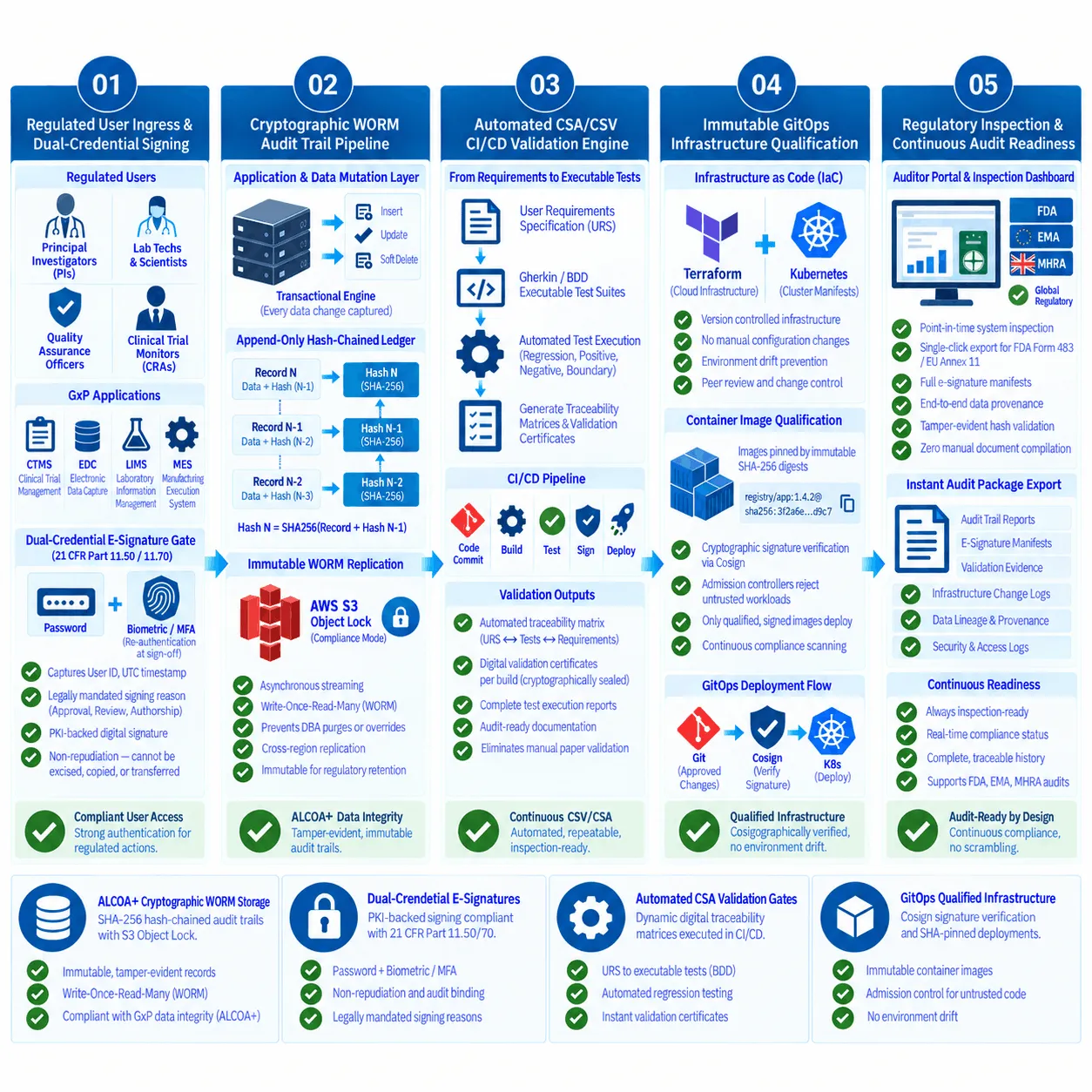
This playbook establishes Codixon's technical framework for engineering GxP-qualified SaaS platforms. By pairing cryptographic hash-chained audit trails, dual-credential cryptographic e-signatures, automated Computerized Software Assurance (CSA/CSV) CI/CD gates, and immutable WORM storage, life sciences platforms achieve continuous regulatory qualification without stalling deployment cycles.
Why Traditional SaaS Architectures Fail FDA Inspections
Treating auditability as an application-level afterthought leads to Form 483 inspection observations, compromised data integrity, and clinical trial halts.
Mutable System Audit Logs
Audit MutabilityStoring historical changes in mutable database tables or application logs allows DBAs or corrupted workers to rewrite timestamps and user identities, failing ALCOA+ data integrity rules.
Single-Factor E-Signature Shortcuts
Invalid SignaturesTreating basic session state or single-button confirmations as legal digital signatures directly violates Part 11 mandates requiring dual-factor re-authentication and explicit signing reasons.
The Validation Freeze Trap
Validation ParalysisRelying on manual paper-based Computerized System Validation (CSV) protocols forces engineering teams to freeze deployments for 6 months per update, stalling critical security patches.
Unqualified Cloud Infrastructure Drift
Environment DriftDeploying to un-pinned cloud resources without strict infrastructure-as-code state locking allows automated upstream patches to alter validated runtime environments undetected.
The 4-Stage Continuous GxP Qualification Framework
A deterministic pipeline enforcing cryptographic data integrity, multi-factor electronic signing, and automated compliance verification.
Cryptographic WORM Audit Trails
Capture every state mutation at the data tier. Chain transaction log entries with SHA-256 hash pointers and replicate events asynchronously to Write-Once-Read-Many (WORM) S3 Object Lock storage.
Dual-Credential Electronic Signatures
Enforce dual-factor re-authentication (password + MFA/biometric) at the precise moment of critical approvals. Bind user identity, timestamp, and legally mandated signing intent into a cryptographically sealed manifest.
Automated CSA/CSV Test Pipelines
Replace paper validation with executable automated test suites in CI/CD. Generate dynamic trace matrices linking user requirements (URS) directly to automated test executions and digitally sealed validation logs.
Immutable GitOps Infrastructure Qualification
Codify complete infrastructure environments via Terraform and Kubernetes manifests. Pin container images by SHA digest and enforce cryptographic signature verification on deployments via Cosign.
Compliance Strategies: Traditional Manual CSV vs. Automated Cloud-Native CSA
Evaluating release velocity, inspection readiness, and engineering overhead across life sciences compliance models.
| Dimension | Legacy Manual CSV Protocols | Cloud-Native Automated CSA Pipeline |
|---|---|---|
| Audit Trail Assurance | Standard database logging susceptible to administrative tampering or accidental schema purge. | Append-only cryptographic hash chaining backed by S3 Object Lock in compliance mode. Guarantees complete ALCOA+ data integrity. |
| Electronic Signature Security | Simple UI checkbox confirmations or standalone SSO assertions lacking embedded signing intent. | PKI-backed cryptographic signing requiring dual credentials and immutable audit bindings. Strict compliance with 21 CFR Part 11.50 and 11.70. |
| Release Cycle & Time to Value | Deployments frozen for 3-6 months while QA teams manually sign hundreds of paper test scripts. | Automated CI/CD validation executes in minutes, generating digital traceability matrices on demand. Enables bi-weekly regulated production releases. |
| Inspection Readiness | Frantic multi-week manual document reconciliation when regulatory auditors issue notice. | Continuous point-in-time audit readiness with zero manual compilation overhead. Eliminates warning letters and Form 483 findings. |
Engineering Guardrails & Trade-Offs
Key architectural prerequisites and operational boundaries for operating GxP cloud-native environments.
When to Apply
- Clinical Trial Management Systems (CTMS), Electronic Data Capture (EDC), and eCOA platforms.
- Manufacturing Execution Systems (MES) and Laboratory Information Management Systems (LIMS) governed by GMP.
- Digital therapeutics and software-as-a-medical-device (SaMD) subject to FDA 21 CFR Part 11 and EU Annex 11.
When to Avoid
- Internal non-GxP productivity tools and enterprise communication platforms without clinical or quality impacts.
- Early-stage exploratory R&D sandboxes prior to formal clinical trial phase transitions.
- Unregulated consumer fitness or lifestyle mobile applications outside FDA oversight.
Operational Caveats
- All time-series audit records must rely on synchronized NTP time sources locked to UTC to prevent timestamp manipulation.
- Electronic signatures must be securely linked to their respective records so they cannot be copied, excised, or transferred.
- Automated test matrices must cover positive, negative, and edge boundary conditions to satisfy auditor scrutiny.
Achieve Continuous 21 CFR Part 11 & GxP Compliance
Partner with our regulatory engineering specialists to audit your cloud architecture, automate validation pipelines, and establish immutable data integrity controls.
- Production-grade 21 CFR Part 11 and EU Annex 11 architectural frameworks
- Automated Computerized Software Assurance (CSA) validation pipelines
- Zero-trust, tamper-evident cryptographic audit log implementations