
Digital Health • Telehealth & Remote Patient Monitoring
Engineering HIPAA-Compliant Video & Biometric Telemetry Gateways
Integrating real-time telehealth video with continuous biometric telemetry across unsecured patient networks presents severe regulatory and operational risks. Standard WebRTC relays, third-party communications APIs, and unsegmented cloud infrastructure frequently violate HIPAA Security Rules, leaving protected health information (PHI) vulnerable to interception and triggering massive civil monetary penalties.
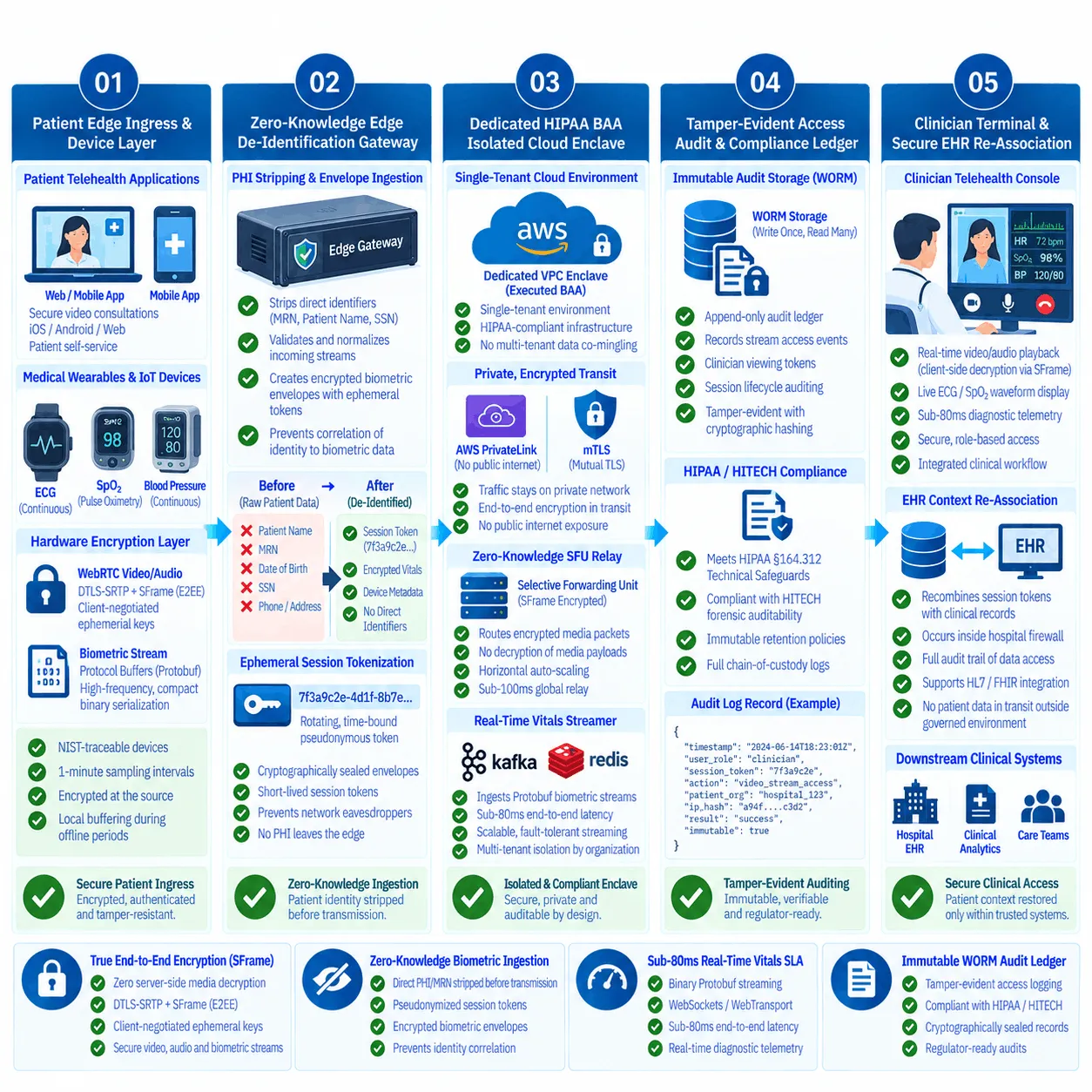
This playbook establishes Codixon's reference architecture for clinical-grade edge-to-cloud communications. By pairing hardware-accelerated SRTP media encryption, zero-knowledge biometric ingestion envelopes, cryptographically isolated BAA network enclaves, and tamper-evident audit logging, healthcare organizations can achieve deterministic, sub-second telemetry delivery while maintaining complete HIPAA and HITECH compliance.
Why Consumer Streaming Tools Breach Clinical Compliance
Treating real-time clinical consultations and high-frequency vitals like standard consumer video streaming leads to statutory security breaches.
The Unencrypted Media Bridge Gap
E2EE ExposureTerminating SRTP sessions inside intermediate cloud transcoding servers without end-to-end payload isolation exposes raw video and audio frames in server memory, violating HIPAA §164.312 requirements.
Third-Party API BAA Disconnects
Contractual BreachRouting patient audio, chat, or vitals through consumer CPaaS platforms that lack executed Business Associate Agreements (BAAs) creates catastrophic compliance liabilities during federal audits.
Biometric Ingestion Header Leaks
Identity ExposureTransmitting patient medical record numbers (MRNs) directly alongside unencrypted ECG, SpO2, and blood pressure telemetry envelopes allows network sniffers to correlate biometric waveforms with individual patient identities.
Non-Auditable Session Ephemerality
Audit BlindspotsFailing to capture immutable, cryptographically sealed access records of precisely which clinician viewed which real-time diagnostic feed leaves health systems defenseless during forensic data access audits.
The 4-Layer Clinical Telemetry Ingestion Pipeline
A zero-knowledge streaming pipeline decoupling patient identity from biometric telemetry streams while maintaining deterministic end-to-end media encryption.
End-to-End SRTP & SFrame Key Exchange
Establish WebRTC media sessions using DTLS-SRTP combined with SFrame encryption. Encrypt audio and video payloads at the client hardware layer with ephemeral keys negotiated out-of-band, preventing intermediate media servers from decrypting video streams.
Zero-Knowledge Biometric Envelope Ingestion
Strip direct identifiers (MRN, Name) from high-frequency telemetry (ECG, pulse oximetry, vitals) at the edge gateway. Encapsulate data in cryptographically sealed binary payloads keyed only by randomized, rotating session tokens.
BAA Enclave Multiplexing & Dedicated VPC Transit
Route encrypted feeds through isolated VPC enclaves bound by executed vendor BAAs. Use private AWS PrivateLink endpoints and mTLS tunnels to eliminate traversal across public internet backbones.
Tamper-Evident Access Logging & State Reconciliation
Record all stream access events, clinician viewing tokens, and session lifecycles to an immutable, append-only ledger backed by WORM storage to satisfy strict HIPAA audit logging mandates.
Architecture Trade-Offs: Public Cloud CPaaS vs. Zero-Knowledge BAA Enclaves
Benchmarking regulatory posture, end-to-end latency, and infrastructure control across telehealth and medical IoT ingestion models.
| Dimension | Generic Public CPaaS / Consumer APIs | Zero-Knowledge HIPAA BAA Enclaves |
|---|---|---|
| Media Payload Encryption | Hop-by-hop encryption. Media is decrypted in memory inside vendor SFU servers for routing and compositing. | True End-to-End Encryption (E2EE) using SFrame. Media remains encrypted across all intermediate routing relays. Eliminates server-side eavesdropping risk completely. |
| Regulatory & BAA Scope | Vendor terms often exclude certain telemetry pipelines, leaving compliance ambiguities for custom IoT payloads. | 100% dedicated single-tenant infrastructure strictly bounded by end-to-end institutional BAAs. Full compliance under HIPAA Security, Privacy, and Breach Notification Rules. |
| Biometric Ingestion Latency | 250ms - 600ms latency due to intermediate API polling and unoptimized JSON serialization overhead. | Sub-80ms real-time vitals streaming via compact binary Protobuf payloads over WebSockets and WebTransport. Enables real-time remote telemetry for surgical and ICU monitoring. |
| Data Ownership & Retention | Session metadata and analytics logs are captured and retained within third-party vendor platforms. | Zero third-party retention; all session metadata, telemetry, and audit logs persist in dedicated enterprise storage. Guarantees complete institutional sovereignty over sensitive clinical data. |
Engineering Guardrails & Trade-Offs
Key architectural prerequisites and operational boundaries for operating HIPAA-compliant telehealth gateways.
When to Apply
- Clinical video consultation platforms handling patient-provider encounters subject to HIPAA and HITECH.
- Remote Patient Monitoring (RPM) platforms ingesting high-frequency biometric streams (ECG, ICU vitals, EEG).
- Decentralized clinical trials requiring direct-from-home physiological data capture paired with live investigator video.
When to Avoid
- General-purpose enterprise corporate video conferencing with zero patient or PHI data exposure.
- Asynchronous medical image archiving (DICOM/PACS) where real-time streaming protocols introduce unnecessary complexity.
- Consumer wellness and fitness tracking wearables outside the scope of HIPAA-covered entities.
Operational Caveats
- Execute and maintain verified Business Associate Agreements (BAAs) with every cloud vendor in the network path.
- Ensure cryptographic keys used for SFrame payload decryption are never accessible to intermediate network proxies.
- Configure automatic session termination and disconnect timeouts after defined periods of participant inactivity.
Build Secure, Clinical-Grade Telehealth & Telemetry Infrastructure
Partner with our digital health systems architects to audit your media pipelines, implement zero-knowledge biometric ingestion, and achieve ironclad HIPAA compliance.
- Production-grade WebRTC SFrame E2EE reference implementations
- Zero-knowledge biometric telemetry ingestion and de-identification frameworks
- Strict alignment with HIPAA Security Rule and HITECH compliance standards