
Healthcare Architecture • Interoperability & Integration
The Death of Batch: Bridging Legacy ANSI X12 EDI to Real-Time HL7 FHIR Streaming
Relying on legacy 72-hour batch drops for ANSI X12 837 claims and 835 remittances cripples clinical revenue cycle performance, inflates administrative denial rates, and fails federal interoperability mandates. Healthcare enterprises continue to bleed working capital while waiting on asynchronous clearinghouse file processing.
This playbook establishes the migration blueprint to retire batch clearinghouses. By pairing event-driven Change Data Capture (CDC), streaming message brokers, in-flight ANSI X12 syntax parsers, and sub-second HL7 FHIR resource transformations, health systems and payers can achieve real-time claims validation, instant eligibility adjudication, and automated pre-submission error scrubbing.
Why Legacy 72-Hour EDI Batches Bleed Healthcare Margins
Treating critical transaction files as opaque, end-of-day SFTP dumps creates multi-day denial loops and blocks clinical workflows.
The 72-Hour Denial Discovery Lag
Delayed AdjudicationSubmitting claims via overnight 837 batch files leaves providers blind to fatal syntax errors, missing modifiers, or lapsed eligibility for up to 3 business days before receiving an 835 remittance.
Opaque Segment Parsing Failures
Batch HaltsCryptic ANSI X12 delimiter errors and loops (e.g., NM1, SBR, CLM segments) fail silently or halt entire batch files, stranding hundreds of valid claims over a single malformed provider identifier.
Dual-Record Master Patient Drift
Patient Index DriftDecoupled clearinghouse feeds and clinical EHR systems update patient demographics asynchronously, leading to conflicting insurance records and downstream medical identity mismatches.
Batch SFTP Infrastructure Fragility
Transfer DropsLegacy point-to-point clearinghouse SFTP drops lack distributed lock leases and automated replay capabilities, creating dropped transmissions during intermittent connectivity lapses.
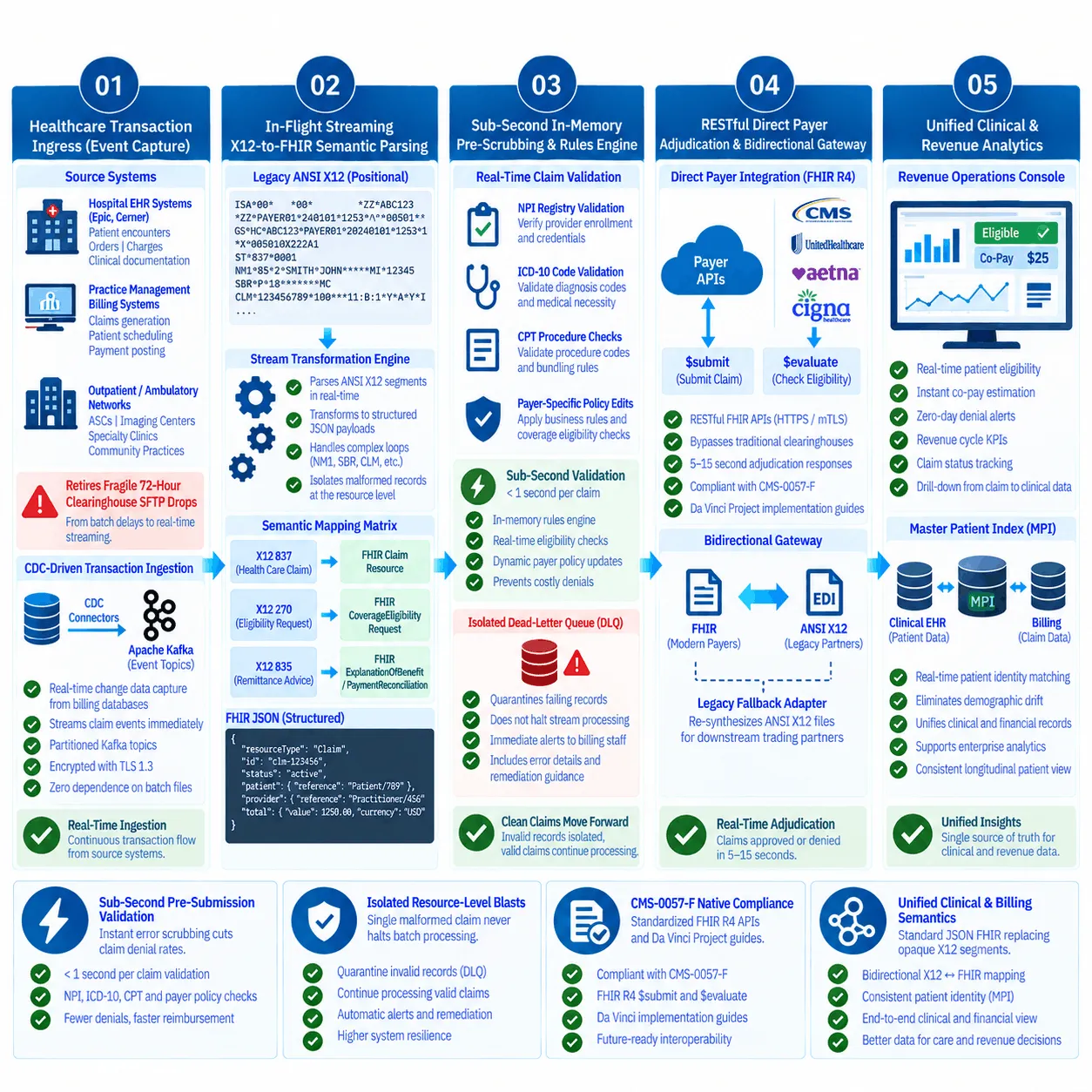
The 4-Stage Real-Time Healthcare Event Fabric
An event-driven streaming pipeline converting transactional ANSI X12 files into validated, interoperable HL7 FHIR R4 resources.
CDC-Driven Transaction Ingestion
Attach lightweight CDC connectors to practice management billing logs and clinical workflows. Capture claim generation events at source and stream them immediately into partitioned event topics.
Streaming X12-to-FHIR Semantic Parsing
Execute in-flight stream processing to decompose X12 loop segments into structured JSON payloads. Dynamically map 837 claims, 270 eligibility checks, and 835 remits into compliant HL7 FHIR Claim and Coverage resources.
Sub-Second Rule Validation & Pre-Scrubbing
Run claims payloads through in-memory clinical rules engines. Validate NPI registries, ICD-10/CPT coding bundles, and payer-specific policy edits prior to outbound transmission.
RESTful FHIR Direct Payer Adjudication
Dispatch claims directly to modern payer endpoints via FHIR RESTful APIs ($submit, $evaluate). Receive synchronous or near-instant adjudication decisions, bypassing multi-day clearinghouse delays.
Architecture Trade-Offs: Batch ANSI X12 vs. Real-Time FHIR Streaming
Benchmarking operational turnaround times, regulatory alignment, and error correction costs between batch clearinghouse workflows and streaming FHIR pipelines.
| Dimension | Legacy Batch ANSI X12 (SFTP) | Event-Driven HL7 FHIR Streaming |
|---|---|---|
| Validation & Adjudication Speed | 48 to 72-hour turnaround time for batch clearinghouse submission, 999 acknowledgments, and 835 responses. | Sub-second pre-submission validation with real-time API adjudication responses within 5 to 15 seconds. Accelerates the revenue collection cycle by days. |
| Error Blast Radius | Syntax or parsing failures often invalidate an entire transmission envelope containing hundreds of claims. | Isolated resource-level evaluation. A single malformed claim is quarantined without halting parallel claims. Maintains continuous cash flow across high-volume departments. |
| Regulatory Compliance | Struggles to satisfy CMS-0057-F Interoperability and Prior Authorization final rules requiring real-time APIs. | Natively compliant with federal FHIR R4 APIs, Da Vinci Project guides, and payer interoperability mandates. Eliminates regulatory audit exposure and non-compliance fines. |
| Data Granularity & Reusability | Rigid, non-human-readable positional string segments accessible only by specialized EDI translation engines. | Standardized, semantically rich JSON FHIR objects directly queryable by clinical dashboards, EHRs, and analytics. Unlocks unified clinical and administrative data analytics. |
Engineering Guardrails & Trade-Offs
Key prerequisites for implementing streaming FHIR architectures and governing HIPAA-compliant data pipelines.
When to Apply
- Health systems and ambulatory networks facing escalating initial claim denial rates (> 8%) due to demographic and coding errors.
- Payers seeking compliance with CMS Interoperability and Prior Authorization APIs (CMS-0057-F).
- HealthTech platforms building digital front doors that require real-time patient co-pay estimation and insurance verification.
When to Avoid
- Legacy trading partners that lack API capabilities and explicitly require fixed-schedule SFTP batch drops.
- Low-volume specialized clinics where weekly manual claim batch uploads satisfy basic accounting workflows.
- Static historical data archiving where real-time transformation confers no business or operational value.
Operational Caveats
- Enforce end-to-end PHI encryption in-transit (TLS 1.3) and at-rest across all Kafka event topics.
- Maintain strict semantic fallback adapters to re-synthesize legacy ANSI X12 files for slower upstream trading partners.
- Implement dead-letter queues (DLQ) with automated alerting for claims failing clinical coding taxonomy checks.
Transition Your Organization from Batch EDI to Streaming FHIR
Collaborate with our healthcare integration architects to audit legacy clearinghouse workflows, eliminate 72-hour batch bottlenecks, and build automated FHIR data pipelines.
- Production-grade ANSI X12 to HL7 FHIR R4 semantic mapping engines
- Strict conformance to HIPAA, CMS-0057-F, and ONC interoperability mandates
- Direct engagement with seasoned enterprise healthcare systems architects