
Logistics & Supply Chain Architecture • Warehouse Systems Modernization
Cloud-Native WMS Modernization: Moving from On-Premise Servers to Streaming EDI
High-throughput fulfillment networks frequently hit operational ceilings due to legacy on-premise warehouse management systems (WMS). Batch-processed EDI exchanges and static warehouse slotting create multi-hour order staging delays, pick-path congestion, and inventory discrepancy errors that ripple across enterprise supply chains.
This playbook establishes Codixon's technical architecture for migrating mission-critical warehouse facilities to cloud-native backbones. By transforming traditional ANSI X12 document batches into event-streamed ingestion pipelines, deploying real-time dynamic inventory slotting engines, and generating optimized coordinate-based 3D picker routes, supply chain operators achieve sub-second order visibility, eliminate shift bottlenecking, and drastically cut travel time across fulfillment floors.
Why Legacy On-Premise WMS Stalls Fulfillment Operations
Relying on nocturnal flat-file EDI batches and rigid monolithic databases causes floor bottlenecks and SLA compliance penalties.
The EDI Batch Processing Lag
Fulfillment LagIngesting ANSI X12 850 (Purchase Orders) via scheduled overnight FTP/AS2 batch jobs delays urgent warehouse fulfillment dispatch by hours after order placement.
Static, Uncalibrated Slotting Rules
Travel OverheadStoring high-velocity SKUs in deep warehouse aisles without automated velocity recalculations forces picker travel distances to escalate during unexpected demand shifts.
On-Premise Hardware Outage Fragility
Operational DowntimeRunning core pick-pack-ship operations on single-point-of-failure local facility servers risks complete warehouse work stoppages during hardware or network failures.
Desynchronized 856 ASN Generation
Retail PenaltiesGenerating Advance Shipping Notices (EDI 856) post-departure via manual batch exports leads to carrier dock rejections and punitive retail chargeback fines.
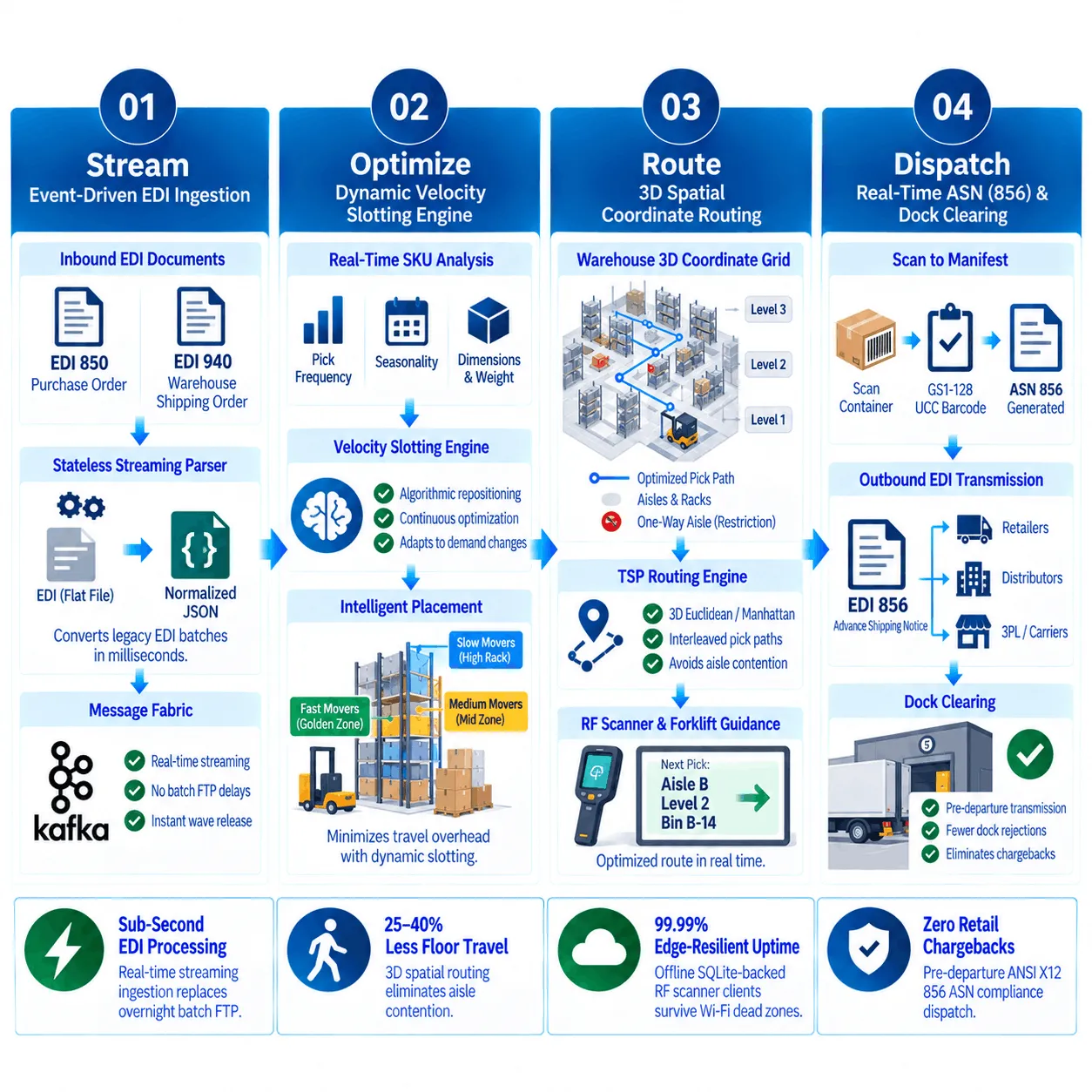
The 4-Stage Real-Time Fulfillment Fabric
A deterministic pipeline linking continuous B2B EDI event streams, dynamic spatial slotting, and automated material handling dispatch.
Event-Driven EDI Parsing & Ingestion
Streamline inbound ANSI X12 850 (Purchase Orders) and 940 (Warehouse Shipping Orders) into JSON payloads via stateless streaming parsers, queuing real-time wave-release intents onto Apache Kafka within milliseconds.
Dynamic Velocity Slotting Engine
Continuously recalculate bin locations using real-time SKU velocity, seasonality, and physical dimensions. Automatically assign fast-moving replenishment items to forward golden-zone pick locations.
3D Coordinate-Based Path Routing
Map warehouse facilities into weighted spatial graph coordinate grids. Generate non-conflicting, interleaved pick-and-pass routes that minimize worker foot travel and eliminate forklift aisle contention.
Real-Time ASN (856) & Manifest Clearing
Generate cryptographic GS1-128 UCC shipping labels and compile ANSI X12 856 Advanced Shipping Notices on scan completion, transmitting compliant EDI manifests before the trailer leaves the yard.
Warehouse Operations: Legacy Monolithic WMS vs. Cloud-Native Event Streaming
Evaluating document ingestion latency, floor labor efficiency, and platform resilience across distribution models.
| Dimension | Legacy On-Premise WMS | Cloud-Native Event-Driven WMS |
|---|---|---|
| EDI Document Throughput | Scheduled batch cycles (hourly or nocturnal), delaying wave planning and inventory allocation. | Streaming ingestion processing EDI transactions (850, 856, 940, 945) in sub-second intervals. Accelerates order drop-to-pick floor latency by up to 90%. |
| Pick Path Efficiency | Static alphanumeric bin sequencing that forces zigzag traversal across congested aisles. | Algorithmic TSP routing based on true Euclidean/Manhattan 3D warehouse coordinate paths. Cuts picker foot travel time by 25% to 40% per shift. |
| Facility Resilience & Scale | Single physical server at each distribution center; local hardware issues halt the entire facility. | Multi-region cloud architecture with offline-capable edge caching on RF hand scanners. Maintains 99.99% picking uptime even through transient internet loss. |
| Multi-Facility Visibility | Siloed local databases requiring manual end-of-day roll-ups to central enterprise ERP. | Unified real-time inventory ledger streaming continuous global stock positions across all sites. Prevents national inventory stockouts and overselling. |
Engineering Guardrails & Trade-Offs
Essential operational boundaries and architecture rules for migrating active warehouse operations to cloud-native architectures.
When to Apply
- Distribution networks running multiple high-bay fulfillment facilities processing over 15,000 lines daily.
- Logistics operations facing punitive retail vendor compliance fines due to late or mismatched EDI 856 ASNs.
- Enterprises transitioning from single-channel freight distribution to unified omnichannel split-case fulfillment.
When to Avoid
- Small regional warehouses with fewer than 500 orders per day where basic ERP stock modules suffice.
- Facilities lacking reliable dual-redundant broadband connectivity or local edge fallback network infrastructure.
- Manual stockrooms operating without barcode scanning, RF devices, or standardized bin locations.
Operational Caveats
- RF scanner mobile web clients must embed local SQLite state to prevent session loss during dead-zone Wi-Fi drops.
- Validate ANSI X12 document schemas against partner trading profiles before streaming to the core Kafka topic.
- Coordinate-based routing algorithms must strictly reflect one-way aisle rules and vertical forklift speed variables.
Modernize Your Warehouse Management Architecture
Collaborate with our logistics systems architects to decouple legacy WMS backbones, implement real-time streaming EDI pipelines, and deploy dynamic 3D route optimization engines.
- Zero-downtime cutover patterns from on-premise legacy WMS
- Real-time ANSI X12 850, 856, and 940 streaming integration engines
- 3D spatial coordinate routing algorithms reducing floor travel times