
Retail & E-Commerce Architecture • Composable Commerce Modernization
MACH Architecture in Practice: Decoupling Monolithic Retail into Composable Commerce
Enterprise e-commerce monoliths frequently bottleneck brand growth, binding catalog updates, dynamic promotions, and checkout flows into tightly coupled, slow-deploying release trains. When peak traffic surges strike, entire platforms risk degradation, while front-end innovation remains constrained by backend server-side template limitations.
This playbook establishes Codixon's technical blueprint for executing a MACH-driven (Microservices, API-first, Cloud-native, Headless) modernization. By decoupling legacy commerce suites into domain-driven microservices, deploying edge-rendered headless Next.js digital storefronts, and engineering distributed, cross-channel persistent shopping carts, retailers achieve sub-second page performance, localized checkout flexibility, and limitless continuous deployment velocity.
Why Legacy Retail Monoliths Choke Enterprise Velocity
Coupled templates, synchronous inventory locks, and shared databases turn simple visual tweaks into multi-week engineering risks.
Monolithic Release Lockstep
Deployment DragTightly integrated presentation and business logic mean minor UI fixes require rebuilding, regression testing, and deploying the entire backend commerce engine.
Cart State Fragmentation
Cart AbandonmentStoring session shopping carts in ephemeral web-server memory leads to cart drops when switching from mobile apps to desktop, hurting multi-channel conversions.
Synchronous Inventory Bottlenecks
Throughput CollapseDirect database locking during high-concurrency promotions exhausts connection pools, causing checkout crashes during peak promotion spikes.
Sub-Par Core Web Vitals
SEO DegradationServer-rendered monolithic HTML templates bloated with legacy jQuery bundles yield sluggish Time-to-Interactive (TTI) and drop organic search rankings.
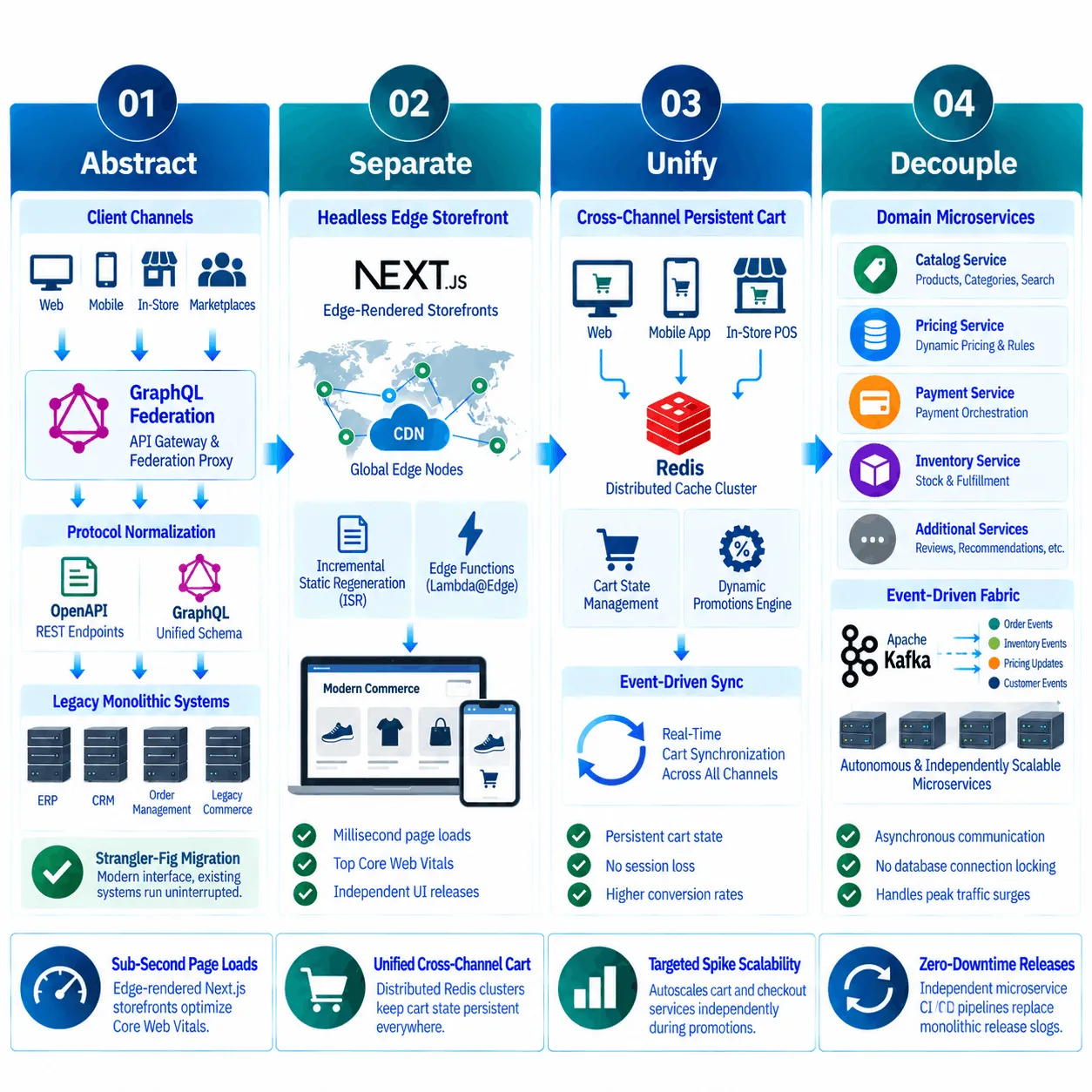
The 4-Stage Composable Strangler Transformation
A deterministic roadmap for carving business capabilities out of legacy suites without risky rip-and-replace cutovers.
API Gateway & Edge Federation Proxy
Position a unified GraphQL federation layer in front of the legacy monolith. Route catalog queries and customer profiles through standardized OpenAPI and GraphQL interfaces while legacy backends continue operating.
Headless Next.js Storefront Deployment
Deploy an edge-rendered Next.js digital experience layer running on global CDNs. Implement Incremental Static Regeneration (ISR) to deliver millisecond page loads while pulling live pricing asynchronously.
Cross-Channel Persistent Cart Subsystem
Extract cart, pricing, and promotion calculations into an event-driven microservice backed by distributed Redis clusters, keeping cart state unified across web, native mobile, and in-store POS.
Autonomous Domain Microservices
Incrementally carve inventory management, payment orchestration, and fulfillment dispatch into isolated, autoscaling microservices communicating via Kafka event buses.
Retail Paradigms: Monolithic Suites vs. MACH Composable Commerce
Analyzing scalability, development agility, and runtime operational efficiency across architectural styles.
| Dimension | Legacy All-in-One Monolith | MACH Composable Architecture |
|---|---|---|
| Frontend Deployment Velocity | Coupled to backend release sprints; bi-weekly or monthly release windows with high blast radiuses. | Independent CI/CD pipelines deploying multiple times daily with zero backend disruption. Enables real-time promotional changes and rapid UX iteration. |
| Peak Traffic Resilience | The entire monolithic stack must scale horizontally, consuming massive database and compute overhead. | Only the bottleneck services (e.g., Cart, Checkout, Inventory) scale dynamically under spike loads. Reduces cloud infrastructure costs during non-peak operational hours. |
| Global Page Latency | Centralized origin servers delivering dynamic server-rendered HTML across high-latency roundtrips. | Globally cached edge HTML with asynchronous client hydration and distributed edge lambdas. Consistently achieves top-percentile Core Web Vitals. |
| Vendor Flexibility | Complete vendor lock-in to the platform's proprietary checkout, CMS, and search mechanisms. | Best-of-breed selection; swap search engines (e.g., Algolia) or CMS layers without touching checkout logic. Shields enterprise brands from costly replatforming cycles. |
Engineering Guardrails & Trade-Offs
Prerequisites and architectural considerations when breaking down retail monoliths into composable microservices.
When to Apply
- Enterprise retailers with over $30M GMV struggling with monolithic deployment release locks and slow page speeds.
- Omnichannel brands requiring synchronized cart and checkout state across web, native apps, and physical POS.
- High-growth merchants running multi-region or multi-brand operations that demand customized digital storefronts.
When to Avoid
- Early-stage D2C brands where turnkey platforms like Shopify Plus satisfy operational needs without custom engineering.
- Merchants lacking dedicated DevOps, platform engineering, or SRE bench capacity to govern distributed microservices.
- Catalogs with simple static inventory and zero dynamic custom bundling or bespoke pricing requirements.
Operational Caveats
- Establish distributed tracing across all microservices from day one to quickly pinpoint inter-service latency bottlenecks.
- Enforce fallback caching policies so frontend storefronts remain browsable even if back-office ERPs experience downtime.
- Codify strict OpenAPI and GraphQL schema versioning rules to eliminate breaking contract changes across federated teams.
Transition Your Retail Monolith to MACH Architecture
Collaborate with our systems architects to decouple legacy commerce suites, implement headless Next.js storefronts, and build unified cross-channel cart engines.
- Zero-downtime strangler-fig migration patterns for high-volume retail
- High-concurrency distributed cart architectures backed by Redis
- Sub-second Core Web Vitals optimization via edge-rendered frontends