
Executive Advisory • Technology Capital Allocation
The Enterprise Build vs. Buy Matrix: Engineering Defensibility vs. Off-The-Shelf Drift
Enterprise technology portfolios are perpetually strained between two financial traps: the multi-million-dollar custom software project that rebuilds commodity wheels, and the sprawling SaaS subscription footprint that forces unique core business processes into generic vendor workflows.
This advisory framework delivers Codixon's quantitative decision matrix for capital allocation. By evaluating competitive differentiation velocity, margin sensitivity, core domain IP ownership, and total five-year cost of ownership (TCO), C-suite executives and investment committees establish clear boundaries: knowing precisely when proprietary engineering builds an unassailable operational moat, and when enterprise SaaS accelerates market entry.
The Four Traps of Flawed Technology Procurement
When strategic intent diverges from software economics, organizations incur crippling technical debt or strategic vulnerability.
Commercial SaaS Suffocation
Process ChokeForcing high-margin, bespoke operating models into rigid off-the-shelf software, forcing armies of human operators into manual spreadsheet workarounds.
Commodity Wheel Reinvention
Sunk CapitalSinking millions in CapEx into custom implementations of non-differentiating systems (e.g., standard billing engines, generic ticketing) with zero market yield.
The Customization Creep Trap
Hybrid DebtPurchasing enterprise SaaS and writing brittle custom plugins that break on every vendor platform upgrade, yielding the high costs of both models with none of the benefits.
Strategic Data Sovereignty Forfeit
Moat ErosionOutsourcing competitive IP, customer interaction signals, and pricing algorithms to third-party vendors who monetize or homogenize your competitive edge across industry rivals.
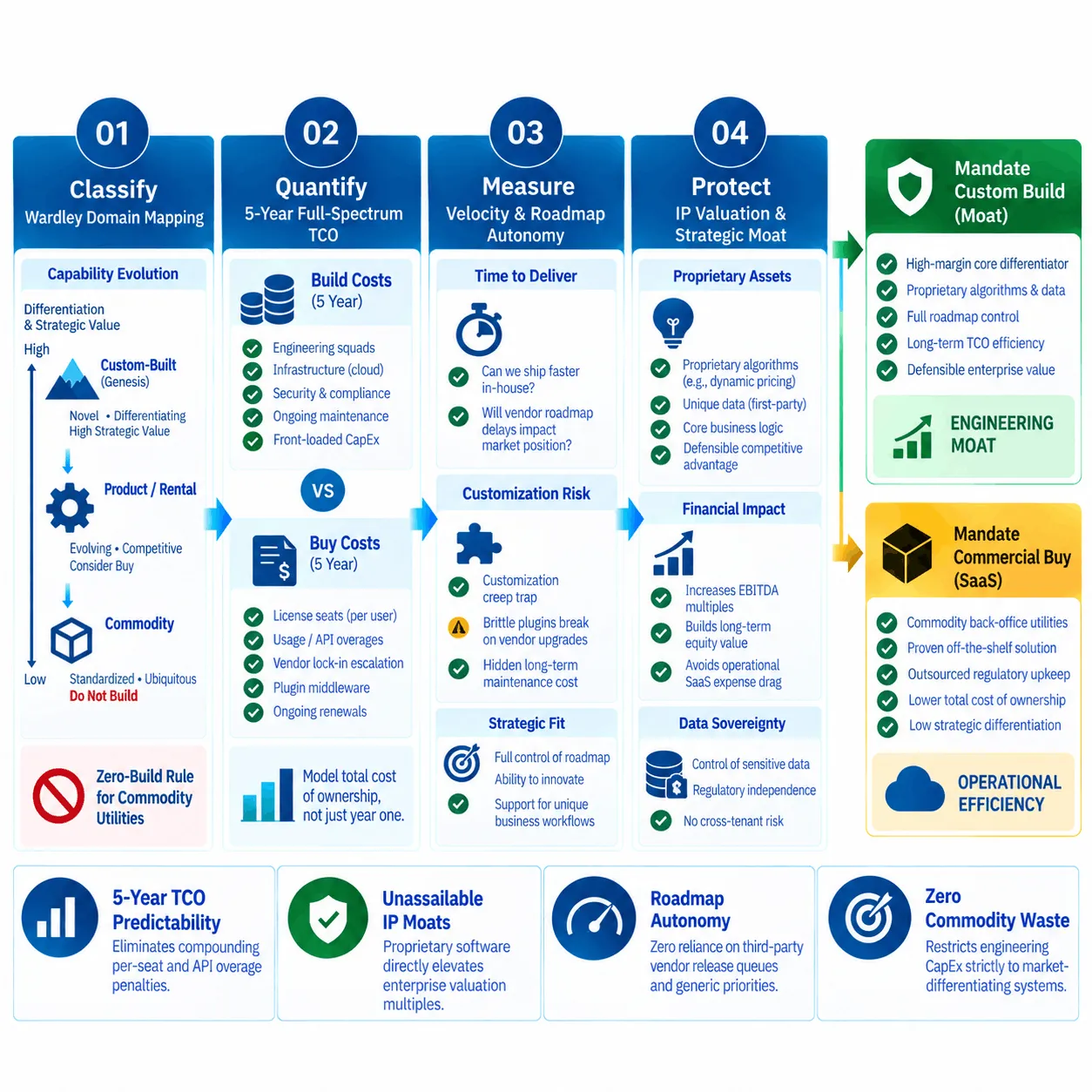
The 4-Pillar Capital Allocation Gate
A structured audit applied by technology steering committees before allocating capital to engineering builds or multi-year SaaS contracts.
Wardley Domain Mapping
Map the business capability along the evolution continuum: Commodity, Product/Rental, or Custom-Built Genesis. Enforce a zero-build mandate for commodity utilities while protecting novel, proprietary business logic.
5-Year Full-Spectrum TCO Modeling
Contrast true build costs (engineering, maintenance, infrastructure, compliance) against realistic buy costs (seat expansion, API call volume surcharges, vendor lock-in escalation, integration middleware).
Velocity & Feature Autonomy Audit
Determine whether waiting on a third-party vendor's public product roadmap threatens market positioning. If feature release cadence dictates gross margins or win rates, custom ownership becomes mandatory.
Moat Defensibility & IP Valuation
Assess enterprise valuation impact. Proprietary, defensible software platforms elevate EBITDA multiples and institutional investor interest; commodity tooling remains an operational expense line item.
Strategic Architecture Matrix: Bespoke Build vs. SaaS Procurement
Evaluating economic impact, competitive positioning, and operational risk across enterprise systems.
| Evaluation Dimension | Proprietary Custom Build | Enterprise Off-The-Shelf SaaS |
|---|---|---|
| Strategic Defensibility | High. Proprietary IP creates structural competitive moats and differentiation that competitors cannot license. | Zero. Competitors can buy the exact same platform tomorrow, equalizing capability instantly. Build solely where your operational workflow is your competitive differentiator. |
| 5-Year Cost Predictability | Front-loaded capital investment with predictable ongoing infrastructure and maintenance costs. | Low barrier to entry followed by aggressive compounding per-seat and usage price escalations. SaaS costs often scale exponentially with transaction volume, eroding margins. |
| Operational Agility | Autonomous backlog control; deploy bespoke features, experiment, and iterate in days. | Constrained by vendor roadmap priorities and generic feature requests from thousands of clients. Bespoke builds eliminate reliance on vendor ticket queues. |
| Maintenance & Upgrade Burden | Internal engineering team retains perpetual responsibility for patches, security, and refactoring. | Fully outsourced to the vendor; infrastructure patching and security updates occur automatically. Buy whenever the domain requires high regulatory upkeep with zero competitive edge. |
Capital Allocation Guardrails
Strict decision gates for board committees, chief digital officers, and finance leaders.
Mandate Custom Build
- The software subsystem directly governs customer retention, algorithmic pricing, or margin-expanding delivery.
- Available market SaaS tools require >30% custom code extension or force inefficient manual operational workarounds.
- Data sovereignty and proprietary transaction logs constitute core intellectual property driving enterprise valuation.
Mandate Commercial Buy
- Commodity enterprise back-office functions (e.g., payroll, standard general ledger accounting, corporate email).
- Domains governed by complex, shifting regulatory compliance where vendors shoulder ongoing legal maintenance.
- Internal applications with fewer than 50 total users where standard SaaS feature parity exceeds operational requirements.
Operational Warning Flags
- Never permit custom builds without committed product ownership and sustained maintenance funding post-launch.
- Watch for hidden SaaS expansion clauses that trigger punitive fee tiers when API call thresholds are crossed.
- Beware of 'low-code' enterprise vendor promises that create closed ecosystems and heavy developer lock-in.
Rationalize Your Enterprise Build vs. Buy Strategy
Collaborate with our strategic technology advisors to evaluate portfolio TCO, audit build defensibility, and establish capital allocation frameworks that protect operating margins.
- Rigorous 5-year full-spectrum TCO and margin impact modeling
- Domain-driven Wardley mapping to isolate true competitive moats
- Objective, vendor-neutral capital allocation recommendations