
Executive Advisory • Architectural Risk & Engineering Governance
Technical Debt Audits: Quantifying Architectural Risk Prior to Capital Allocation
Boardrooms and investment committees routinely commit tens of millions of dollars to platform rewrites based on anecdotal developer frustration rather than rigorous diagnostic evidence. Without an empirical audit quantifying actual architectural decay, enterprise rewrites consistently run over budget, slip deadlines, and recreate the exact same systemic failure modes they sought to resolve.
This advisory playbook outlines Codixon's technical debt audit framework for pre-investment scrutiny. By combining automated dependency graph analysis, test suite determinism metrics, single-point-of-failure (SPOF) stress modeling, and git-based developer cycle forensics, technology leaders can quantify engineering risk into defensible balance-sheet variables before approving major capital allocations.
The Four Invisible Risks That Sink Platform Rewrites
When capital is deployed without objective architectural discovery, enterprise projects stumble into avoidable structural quicksand.
Hidden Cyclic Coupling
Entanglement RiskUnmapped, entangled dependencies between supposedly isolated domains make clean modular extraction impossible without rewriting the entire core at once.
Non-Deterministic Test Suites
Verification LossFlaky end-to-end integration tests that pass or fail unpredictably erode deployment confidence and force teams into weeks of manual regression testing.
Undocumented Single Points of Failure
Systemic FragilityObscure stored procedures, unmaintained cron daemons, or single un-clustered message brokers that quietly underpin mission-critical transactions.
Developer Velocity Drag & Churn
Throughput CollapseEngineers spending over 60% of their sprints resolving merge conflicts, waiting on multi-hour local builds, and performing manual smoke verifications.
The 4-Stage Pre-Allocation Architectural Audit
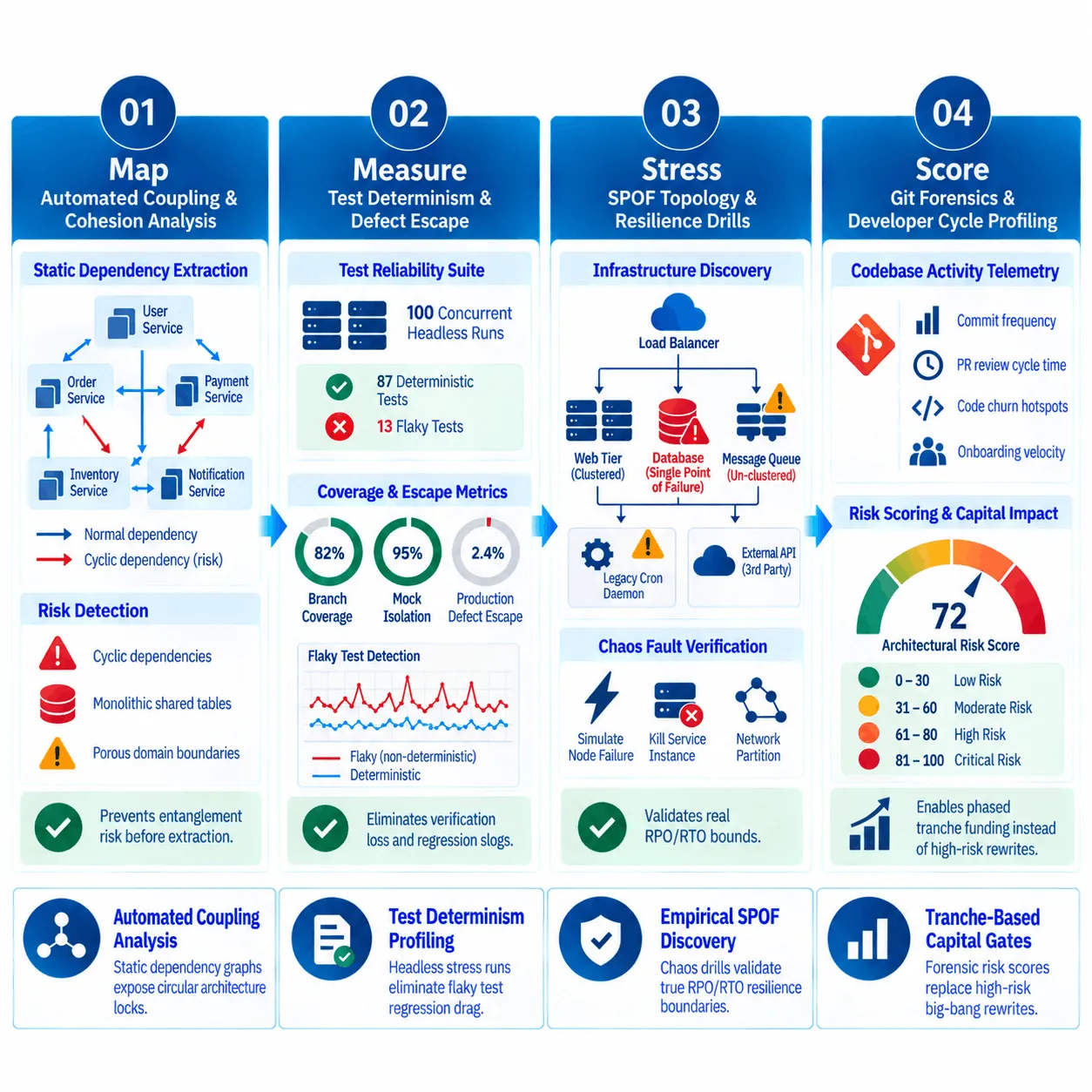
A deterministic discovery pipeline transforming opaque codebases into measurable, board-ready risk scores.
Automated Coupling & Cohesion Analysis
Execute static dependency graph extraction and calculate afferent/efferent coupling indices. Identify circular dependencies, monolithic shared database tables, and tightly bound domain boundaries.
Test Determinism & Defect Escape Audit
Calculate test suite pass reliability across 100 concurrent headless runs. Measure branch coverage depth, mock isolation fidelity, and historical production defect escape ratios per module.
SPOF Topology & Disaster Recovery Drill
Map physical compute, storage, and networking layers to identify architectural bottlenecks. Perform automated Chaos Engineering drills to verify database failover latencies and data loss bounds (RPO/RTO).
Git Forensics & Developer Cycle Profiling
Analyze commit frequencies, PR review cycle times, code churn hotspots, and onboarding ramp velocities to establish a baseline developer friction score and identify highest-leverage intervention targets.
Capital Deployment: Intuition-Driven Rewrites vs. Audited Modernization
Comparing project predictability, delivery risk, and capital efficiency across software investment approaches.
| Evaluation Dimension | Intuition-Driven 'Big Bang' Rewrite | Empirically Audited Modernization |
|---|---|---|
| Capital Risk Profile | High. Full capital expenditure committed upfront based on high-level estimates; 80%+ historical failure or scope reduction rate. | Low. Phased tranche funding unlocked by empirical risk milestones and proven domain strangulation. Mitigates downside financial exposure for executive sponsors and boards. |
| Operational Disruption | Extended feature freezes on legacy systems while engineering pivots entirely to the new platform. | Zero feature freeze; incremental strangler decoupling delivers continuous business enhancements. Protects market competitiveness and uninterrupted customer revenue. |
| Scope & Requirement Accuracy | Relies on outdated documentation and team memory; misses obscure edge cases until launch. | Static code forensics and runtime telemetry map exact data contracts and transactional invariants. Guarantees parity for mission-critical business rules and compliance logic. |
| Time-to-Value Realization | Deferred until complete system cutover, typically requiring 18 to 36 months. | Value delivered incrementally in 6 to 12-week cycles as decoupled domains go live. Accelerates payback on engineering capital expenditure. |
Pre-Capital Allocation Guardrails
Decision rules for enterprise boards, investment committees, and technology sponsors prior to budget approvals.
Mandate an Empirical Audit
- Proposed rewrite or modernization budgets exceed $2M in direct capital expenditure.
- Engineering velocity has slowed by more than 40% over consecutive quarters without clear root-cause consensus.
- Mergers and acquisitions (M&A) technical due diligence requires assessing software asset valuations and liabilities.
Reject Full Rewrite Proposals
- Proposals lacking a comprehensive mapping of existing business logic, edge cases, and automated integration tests.
- Initiatives demanding a multi-quarter 'feature freeze' on core customer-facing applications.
- Projects pitched solely on developer preference for newer frameworks without quantifiable business ROI.
Operational Warning Flags
- Ensure internal engineering teams understand the audit is diagnostic, not punitive, to ensure transparent cooperation.
- Audit findings must directly translate technical findings into financial liabilities (e.g., lost productivity, downtime risk).
- Verify that test environment topologies mirror production configurations before declaring test suites non-deterministic.
Quantify Your Architectural Risk Before Allocating Capital
Collaborate with our systems architects and forensic analysts to execute an empirical technical debt audit, evaluate true system coupling, and de-risk your platform investments.
- Objective automated dependency mapping and cyclic coupling discovery
- Empirical developer cycle time and test determinism benchmarking
- Actionable strangler-fig modernizations backed by balance-sheet metrics