
Executive Advisory • Balance Sheet & Tech Debt Governance
The Total Cost of Ownership of Monolithic Lock-In
Enterprise balance sheets rarely record legacy tech debt directly, yet its financial drag silently depresses operating margins and slows corporate agility. When systems age into monolithic lock-in, the true expense is not simply software maintenance—it is a compounding liability of escalating vendor support contracts, prolonged hiring cycles for extinct skillsets, and crippled time-to-market.
This advisory playbook provides C-suite leadership and audit committees with a comprehensive framework to quantify the full balance-sheet impact of legacy monoliths. By evaluating escalating vendor renewal premiums, engineering talent acquisition premiums, release-cycle friction costs, and revenue opportunity loss, executives can formulate an indisputable financial justification for incremental decoupling.
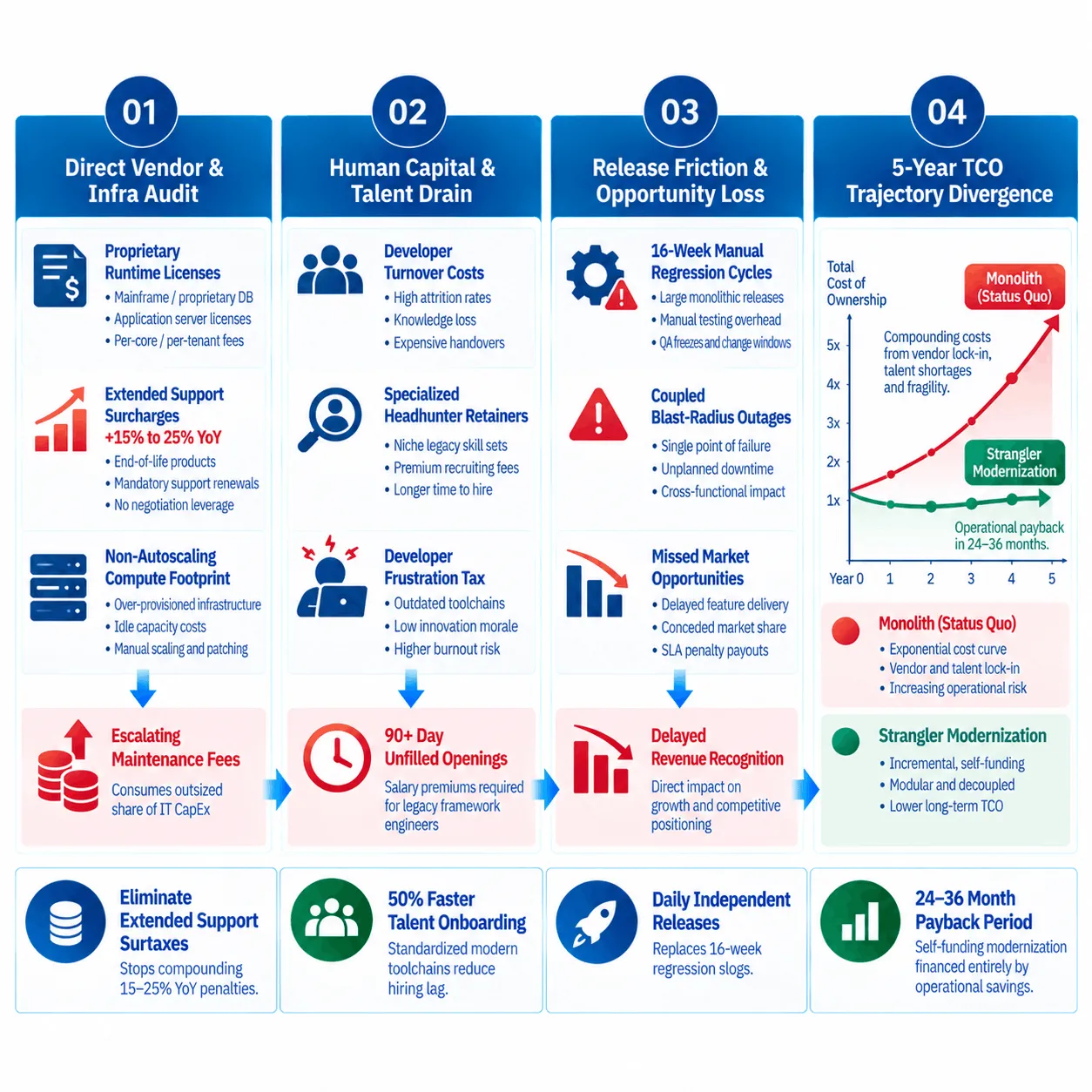
The Four Compounding Cost Multipliers of Monoliths
Direct IT line items obscure the deeper operational and commercial penalties that erode enterprise valuation.
Extortionate Extended Support Tiers
Vendor SurchargeLegacy enterprise vendors charge compounding annual premiums (often 15% to 25% year-over-year) simply to preserve end-of-life security patches on obsolete runtimes.
The Legacy Talent Acquisition Premium
Talent DrainRecruiting engineers fluent in proprietary, decade-old frameworks demands elevated salary premiums, prolonged recruiter retainers, and prolonged onboarding timelines.
Opportunity Cost of Release Slog
Market DelayWhen routine digital feature iterations require 16-week regression cycles instead of daily deployments, commercial revenue opportunities are continuously conceded to competitors.
Fragile Blast Radius Overhead
Failure ContagionBecause tightly coupled codebases lack domain boundaries, minor hotfixes frequently trigger cascading failures in unrelated modules, inflating customer support and SLA penalties.
The 4-Pillar Tech Debt Quantification Methodology
A deterministic approach for CFOs, CIOs, and auditors to surface the hidden financial liabilities within enterprise software portfolios.
Direct Vendor & Infrastructure Audit
Aggregate all explicit expenditures: proprietary runtime licenses, compounding extended-support fees, inflated compute footprints for non-autoscaling workloads, and specialized backup infrastructure.
Human Capital & Productivity Benchmarking
Calculate developer turnover costs, hiring agency retainers, and the 'developer frustration tax' caused by legacy toolchains that hinder senior engineering recruitment and retention.
Release Latency & Quality Loss Modeling
Translate delayed feature deliveries, manual end-to-end regression cycles, and emergency downtime incidents into concrete lost business revenue and contractual SLA penalty metrics.
5-Year Run-Rate & Modernization Projections
Model the divergence: compare status-quo maintenance escalation against a staged, incremental decoupling plan that repays debt through operational savings within 24 to 36 months.
Cost Trajectory: Monolithic Status Quo vs. Modular Modernization
Contrasting the compounding operational drain of legacy lock-in against the capital economics of modern architectures.
| Cost Dimension | Legacy Monolithic Lock-In | Decoupled Modular Architecture |
|---|---|---|
| Vendor Licensing Trajectory | Compounding annual increases with punitive lock-in clauses and mandatory upgrade fees. | Commoditized cloud infrastructure and open-source foundations with predictable, elastic costs. Eliminates vendor hold-up risks and unexpected license fee escalations. |
| Engineering Talent Sourcing | Shrinking talent pools; premium compensation required to lure developers to obsolete stacks. | Abundant talent market using modern, standardized tooling; faster onboarding and higher retention. Reduces developer churn and time-to-hire by over 50%. |
| Deployment Cycle Economics | Multi-month release trains involving manual QA war rooms and elevated deployment risk. | Independent continuous delivery pipelines deploying bounded domains multiple times daily. Accelerates revenue recognition and time-to-market for digital initiatives. |
| System Availability Risk | A fault in a single non-critical subsystem can cascade into global enterprise application outages. | Fault domains are strictly isolated; resilient fallback circuits preserve core business operations. Shields core enterprise revenue and contractual SLA commitments. |
Technical Debt Capital Guardrails
Capital discipline rules for steering committees, finance executives, and engineering leaders.
When to Modernize Urgently
- Annual vendor extended-support licensing surcharges exceed 20% of the platform's initial deployment cost.
- Feature delivery cycle time exceeds 8 weeks, directly impacting competitive win rates or customer retention.
- Open engineering roles for the platform sit unfilled for more than 90 days due to candidate stack aversion.
When to Defer Investment
- Static back-office workloads scheduled for full enterprise retirement or phase-out within 18 months.
- Self-contained utilities with stable business logic that require zero feature modifications or scaling adaptations.
- Organizations in the middle of active M&A restructuring where platform consolidation targets remain unfinalized.
Operational Warning Signs
- Avoid 'big bang' complete rewrites; they carry an 80%+ historical failure rate in enterprise portfolios.
- Always mandate incremental, domain-bounded strangler migrations with measurable quarterly ROI checkpoints.
- Audit and decommission unused software modules; do not waste capital migrating defunct business features.
Quantify and Eliminate Your Monolithic Lock-In
Collaborate with our technology advisors and financial architects to measure the true balance-sheet burden of your legacy platforms and engineer self-funding modernization roadmaps.
- Objective balance-sheet tech debt quantification and TCO modeling
- Incremental strangler-fig migration roadmaps funded by operational savings
- Proven architectural patterns eliminating proprietary vendor lock-in