
Executive Advisory • Security, Governance & Operational Trust
Architecting for Resilience: Designing Zero-Downtime Deployment Rails for Mission-Critical Apps
In mission-critical enterprise environments—spanning algorithmic trading, healthcare telemetry, and real-time logistics—maintenance windows and planned outages are unacceptable business risks. Yet, legacy deployment methodologies still force scheduled midnight downtime, manual database lockouts, and nail-biting cutover weekends that frequently end in catastrophic rollback scrambles.
This advisory playbook outlines Codixon's engineering framework for designing resilient, zero-downtime deployment rails targeting 99.999% platform availability. By orchestrating blue-green routing cutovers, automated statistical canary rollouts, expand-and-contract non-destructive schema migrations, and proactive Chaos Engineering drills, engineering leadership eliminates deployment-induced downtime and releases software continuously with zero disruption to active customer transactions.
The Four Traps of Fragile Enterprise Deployment Pipelines
When deployment tooling lacks automated guardrails and backwards-compatible data abstractions, release trains threaten business continuity.
The Destructive Schema Migration
Schema LockExecuting table-locking DDL migrations (e.g., dropping or renaming active columns) halts live database queries, crashing active user sessions and checkout carts.
All-or-Nothing Cutover Cascades
Blast RadiusRouting 100% of production traffic instantly to new container revisions exposes the entire user base to dormant edge-case bugs and memory leaks.
Manual Rollback Panic
MTTR SpikeLacking automated, metric-driven rollbacks leaves incident response to stressed engineers scrambling through manual database backups while downtime clocks tick.
Untested Disaster Recovery Plans
DR BlindspotRelying on theoretical failover documentation that has never been stressed under simulated chaos conditions guarantees unexpected failure during real-world cloud outages.
The 4-Pillar Continuous Availability Framework
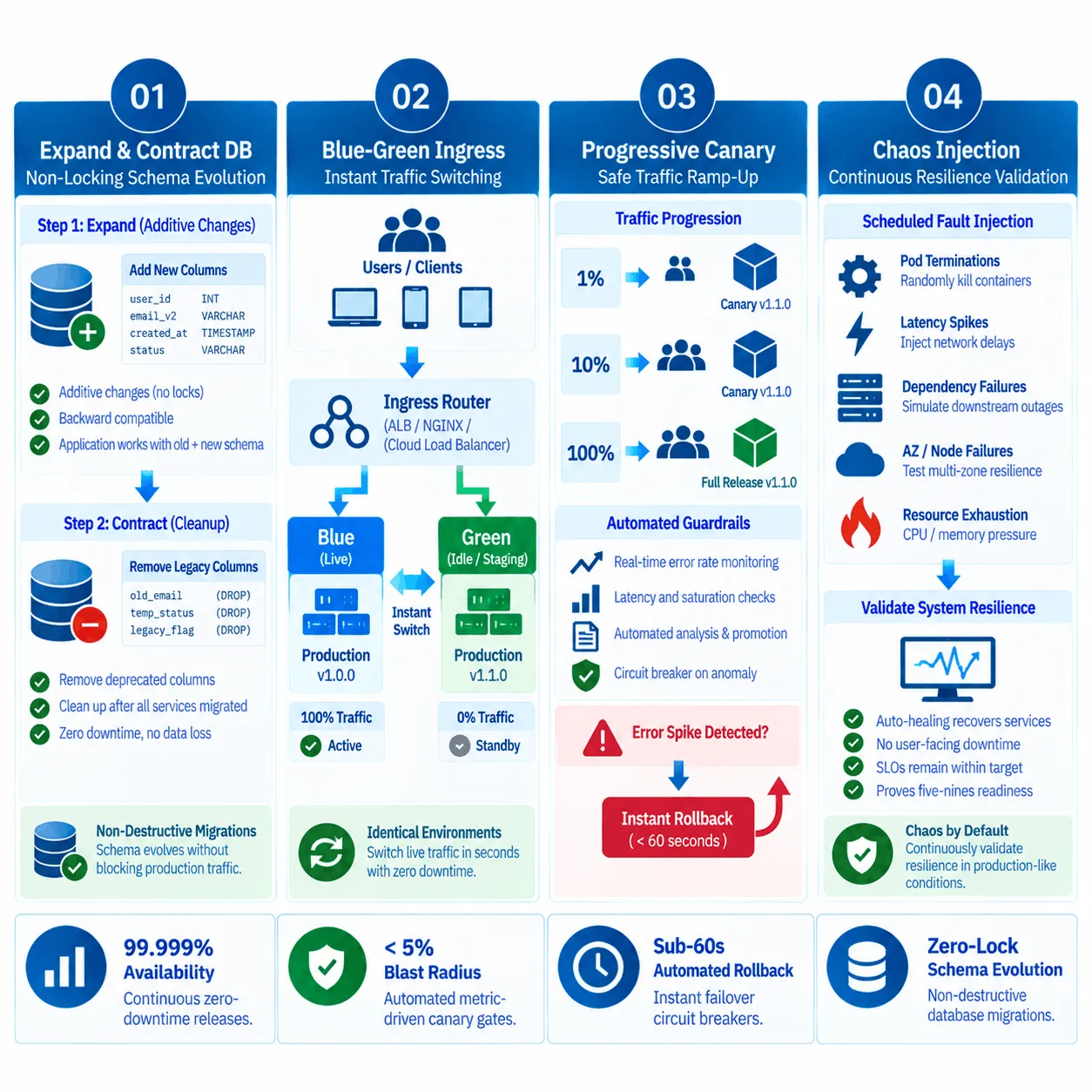
A deterministic deployment pipeline decoupling code releases from feature exposure while preserving continuous database backward compatibility.
Expand & Contract Database Evolution
Decouple database schema updates from code deployments. First expand the schema with additive, nullable columns and dual-writing proxies; deploy application code; and contract legacy fields only after all services migrate.
Blue-Green Ingress Routing
Maintain two identical, isolated production environments. Deploy new container releases entirely into the idle green environment, execute automated synthetic health checks, and shift ingress load-balancer traffic instantaneously.
Automated Canary & Metric-Driven Rollback
Gradually bleed production traffic (1%, 5%, 25%, 100%) to the canary deployment. Analyze real-time error rates, HTTP 5xx responses, and P99 latency thresholds with automated rollback circuit breakers in under 60 seconds.
Continuous Chaos Engineering & Fault Drills
Run automated chaos experiments in staging and production (e.g., Chaos Mesh, LitmusChaos) to inject simulated network latency, pod kills, and regional database failovers, proving five-nines resilience empirically.
Enterprise Deployments: Maintenance Windows vs. Automated Zero-Downtime Rails
Evaluating revenue exposure, blast radius control, and recovery times across deployment methodologies.
| Operational Dimension | Scheduled Maintenance Outages | Continuous Zero-Downtime Rails |
|---|---|---|
| Platform Availability (SLA) | 99.0% to 99.5% availability; multiple hours lost monthly to scheduled midnight maintenance windows. | 99.999% availability; continuous deployments execute during peak operational daylight hours with zero downtime. Prevents contractual enterprise SLA breaches and customer churn. |
| Deployment Blast Radius | 100% of users impacted simultaneously if an unhandled regression slips past QA staging. | Restricted to 1% to 5% of traffic during canary evaluation; automated abort halts impact immediately. Protects business reputation and customer transaction integrity. |
| Database Rollback Risk | High risk; restoring a multi-terabyte database backup requires hours of total operational suspension. | Zero risk; non-destructive expand-and-contract patterns preserve full backward code compatibility. Eliminates database-induced data corruption and loss during rollbacks. |
| Mean Time to Recover (MTTR) | 45 to 180 minutes involving war rooms, incident diagnosis, and manual environment restoration. | Sub-60-second automated routing rollback triggered by metric-driven canary anomaly detection. Dramatically compresses operational incident recovery times. |
Zero-Downtime Architecture Guardrails
Mandatory operating rules for VP of Infrastructure, site reliability engineers, and enterprise architects.
Mandate Zero-Downtime Rails
- Platforms where 1 minute of outage results in direct financial transaction loss or regulatory non-compliance.
- Global multi-region applications where no off-peak maintenance window exists due to worldwide user concurrency.
- High-velocity product organizations deploying code revisions multiple times per day across microservices.
Prohibit Outdated Practices
- Executing in-place destructive schema modifications directly on active production database master instances.
- Allowing deployments without automated metric-driven health checks and automated rollback triggers.
- Scheduling off-hours 'hero deployments' without on-call SRE automation and verified observability dashboards.
Operational Warning Signs
- Always verify that canary metrics evaluate business transactions (e.g., successful orders) rather than just CPU usage.
- Ensure all long-running background worker processes support graceful shutdown (SIGTERM) without dropping queued jobs.
- Run chaos drills during normal business hours when full engineering staff is present to handle unforeseen edge cases.
Achieve Continuous Five-Nines Availability
Collaborate with our reliability and cloud systems architects to design automated canary rails, implement expand-and-contract database migrations, and de-risk your deployment operations.
- Automated blue-green and metric-driven canary deployment routing
- Non-destructive expand-and-contract database migration patterns
- Empirical Chaos Engineering frameworks for verified 99.999% platform availability