
Executive Advisory • Security, Governance & Operational Trust
Security & Compliance by Design: Navigating SOC 2, HIPAA, and ISO 27001 in Bespoke Code
Enterprise compliance has traditionally operated as an expensive, post-facto audit marathon—weeks spent compiling screenshots, chasing access spreadsheets, and retrofitting security patches days before external inspectors arrive. In modern custom software engineering, treating security as an afterthought stalls sales cycles, inflates audit overhead, and leaves catastrophic data vulnerability gaps.
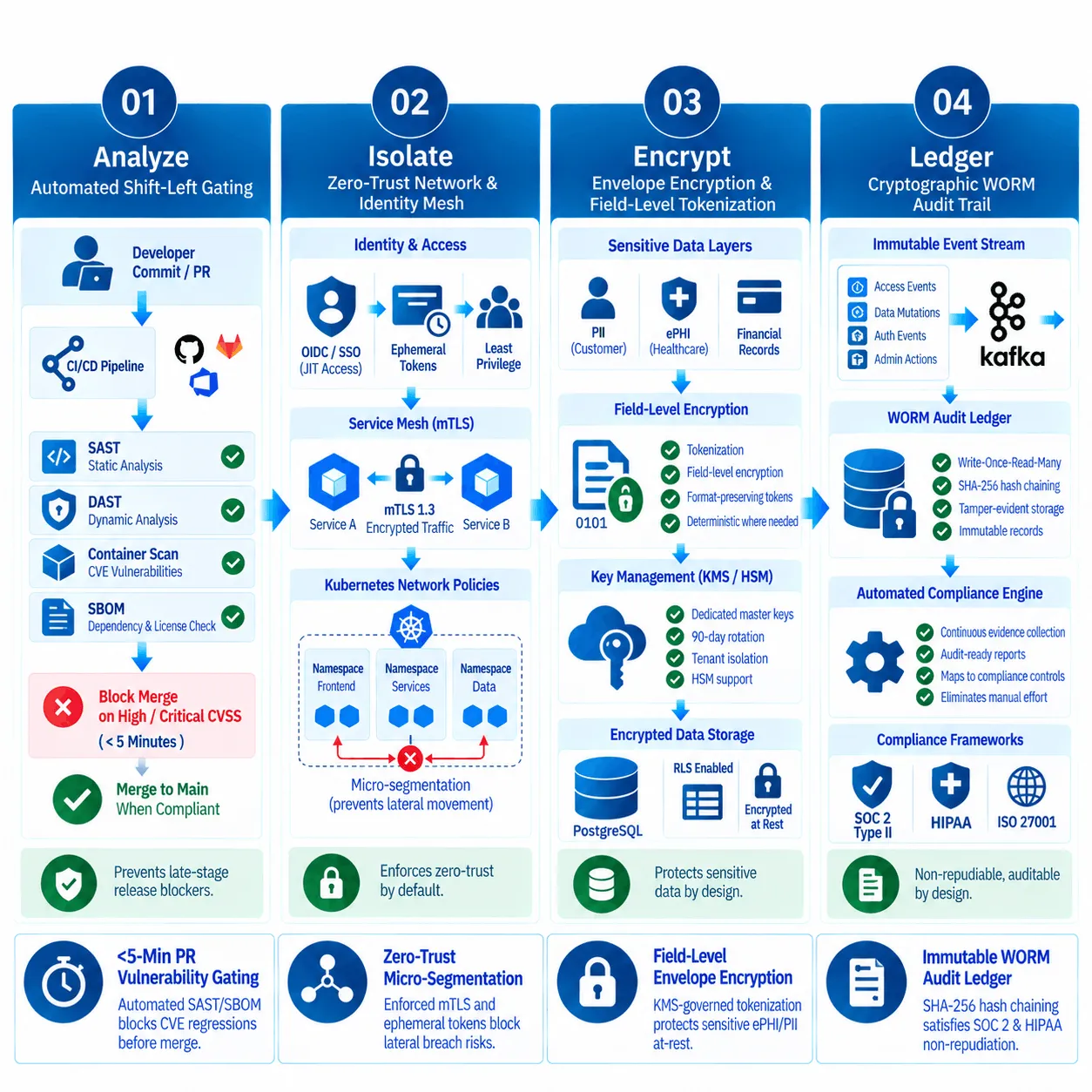
This advisory playbook outlines Codixon's framework for embedding regulatory compliance directly into application architecture and CI/CD automation. By shifting security left through automated static analysis, pull-request vulnerability gating, zero-trust network policies, and cryptographic append-only audit ledgers, engineering leadership converts SOC 2 Type II, HIPAA, and ISO 27001 mandates from commercial bottlenecks into continuous, demonstrable competitive differentiators.
The Four Traps of Retrospective Security Governance
Bolting compliance controls onto insecure application foundations wastes capital and exposes enterprises to severe regulatory penalties.
The Screenshot-Audit Slog
Audit DragDraining senior engineering hours during annual audit windows to manually take console screenshots and reconcile Jira access tickets across siloed platforms.
Late-Stage Pipeline Blockers
Release LockPostponing vulnerability scanning until right before production release, causing emergency sprint cancellations when unpatched container CVEs are discovered.
Porous Flat-Network Assumptions
Lateral RiskTreating internal service networks as trusted zones without micro-segmentation, allowing a breach in a non-critical microservice to pivot directly to protected customer PII/ePHI.
Mutable Log Tampering Exposure
Non-Repudiation LossPersisting application access logs in standard relational database tables where administrative users can modify timestamps or delete forensic audit trails.
The 4-Pillar Shift-Left Compliance Fabric
A deterministic pipeline transforming regulatory mandates into automated code assertions and immutable proof artifacts.
Automated SAST, DAST & Dependency Gating
Embed static application security testing (SAST), software bill of materials (SBOM) generation, and container image vulnerability scanners directly into pull request checks. Block merges automatically on high/critical CVSS vulnerabilities.
Zero-Trust Network Policies & mTLS
Enforce least-privilege service-to-service communication via Kubernetes network policies and mutual TLS (mTLS) service meshes. Ensure every payload traversing internal clusters is authenticated and encrypted in transit.
Envelope Encryption & Field-Level Tokenization
Protect sensitive ePHI and financial records using field-level application encryption before data ever reaches database disks. Manage encryption keys via dedicated cloud KMS modules with automated 90-day rotation.
Cryptographic Append-Only Audit Logging
Stream access and mutation events into an immutable, write-once-read-many (WORM) audit ledger with SHA-256 hash chaining, guaranteeing non-repudiation and real-time evidence generation for external auditors.
Compliance Execution: Annual Retrospective vs. Continuous Code-Level Design
Evaluating operational overhead, vulnerability window duration, and audit readiness across regulatory postures.
| Security Dimension | Retrospective Annual Audit | Compliance-by-Design Architecture |
|---|---|---|
| Audit Evidence Collection | Hundreds of engineering hours spent manually capturing screenshots and pulling git histories. | Continuous, automated evidence collection generated directly by CI/CD pipeline assertions. Reduces annual compliance prep time by over 80%. |
| Vulnerability Remediation Latency | Identified months after deployment during annual third-party penetration testing engagements. | Flagged and blocked in under 5 minutes on developer pull requests prior to merging. Eliminates production security debt before deployment. |
| Access Control & Tenancy Boundaries | Application-level filters and shared credentials prone to human coding oversights. | Enforced database Row-Level Security (RLS), RBAC/ABAC policies, and ephemeral OIDC tokens. Eliminates cross-tenant data contamination risks entirely. |
| Enterprise Sales Cycle Impact | Lengthy InfoSec vendor questionnaire reviews that stall closing enterprise deals by months. | Immediate issuance of clean, automated SOC 2 / ISO compliance reports accelerating deal closes. Transforms compliance from a cost center into a commercial sales enabler. |
Compliance Engineering Guardrails
Critical security heuristics for CISOs, compliance officers, and engineering leadership.
Mandate Continuous Controls
- Applications handling electronic protected health information (ePHI), cardholder data (PCI-DSS), or corporate financial ledgers.
- B2B SaaS platforms selling into Fortune 500 or heavily regulated enterprise procurement funnels.
- Distributed microservices requiring rigorous zero-trust mutual authentication across cloud VPCs.
Prohibit Flawed Practices
- Storing long-lived static API secrets or cloud credentials in source repositories or container environment files.
- Granting developers broad write access to production database instances without audited just-in-time (JIT) access proxies.
- Treating compliance evidence collection as a once-a-year manual engineering sprint.
Operational Warning Signs
- Maintain strict statutory separation between operational production data stores and analytics/staging environments.
- Ensure all cryptographic keys are managed through dedicated hardware security modules (HSMs) or cloud KMS.
- Continuously test disaster recovery failovers with real data corruption drills rather than relying on paper plans.
Architect Continuous Compliance into Your Enterprise Software
Collaborate with our security and systems architects to embed shift-left compliance gating, zero-trust network policies, and cryptographic audit logging directly into your application codebase.
- Automated shift-left CI/CD gating for SOC 2, HIPAA, and ISO 27001
- Zero-trust micro-segmentation and envelope encryption architectures
- Immutable append-only audit ledgers providing cryptographically verified non-repudiation